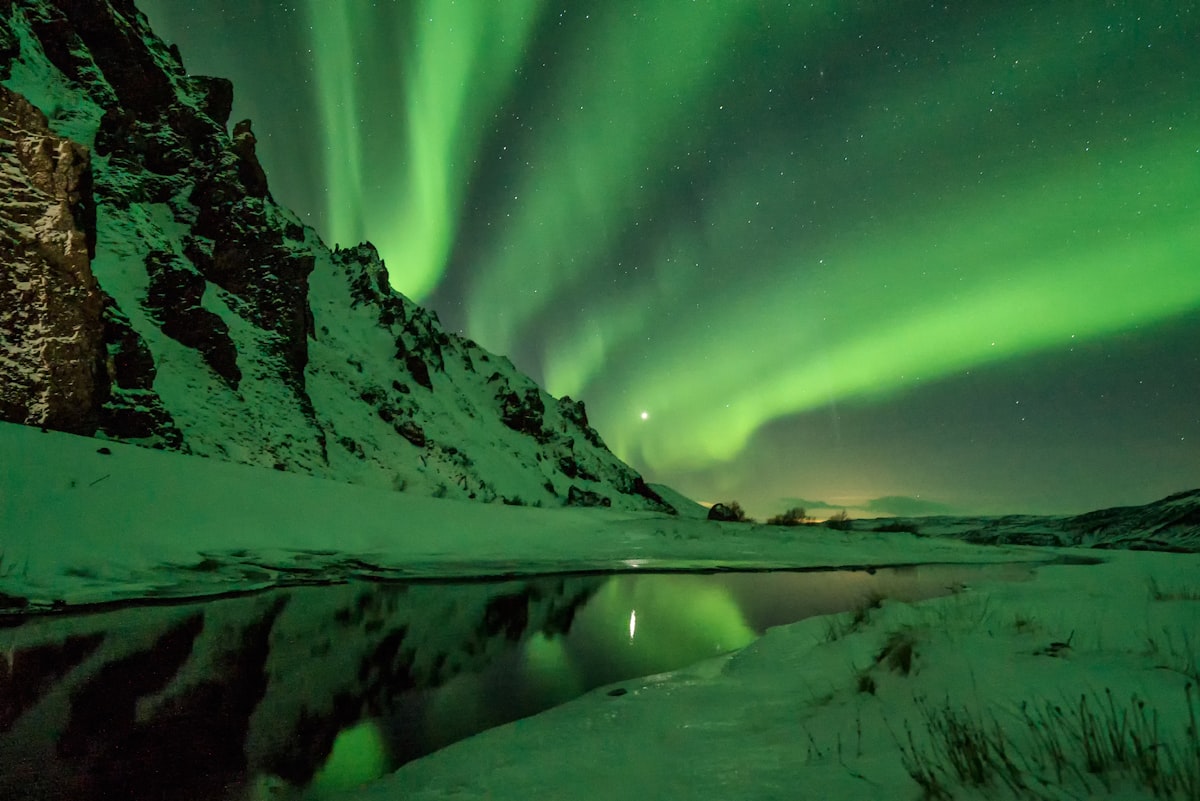
If October is when Iceland’s aurora season hits full stride, November is when darkness stops being a limiting factor at all. By now the long summer is a distant memory: the sun barely clears the horizon, and the night is so long you don’t have to plan around it. For the first time in the season, the question isn’t “will it be dark enough?” — it always is. The question is “will the sky be clear?”
That single shift defines November. Here’s an honest look at what the month offers in 2026, and how to plan around its real strength and its real weakness.
Deep Darkness Has Fully Arrived
In October you still got convenient early-evening darkness with a sensible bedtime. November takes it much further. By November 1, the sun sets around 16:55 in Reykjavík and the sky is fully dark well before 19:00. By November 30, sunset is before 15:50 and sunrise isn’t until almost 11:00 — barely five hours of daylight. (Iceland stays on UTC year-round, so there’s no clock change to track.)
That leaves roughly 16 to 18 hours of darkness by late November, climbing toward the December solstice maximum. The practical effect is that the aurora can be visible almost any time after dinner. You no longer have to choose between a sighting and a night’s sleep, and the enormous dark window means you’ll be awake for far more of the sky’s unpredictable bursts. The aurora is bursty by nature — the more dark hours you’re outside watching, the better your odds. The 22:00–01:00 window is still the statistical sweet spot for the strongest displays; for why, see our guide to the best time of night to see the northern lights.
November’s Real Challenge: Storms and Cloud
Here’s the honest catch, and it’s sharper in November than in any earlier month. Darkness is no longer the constraint — weather is. November is statistically one of Iceland’s cloudiest and stormiest months, when the North Atlantic’s winter storm track sets in for real. October hinted at this; November delivers it.
But “cloudiest on average” is not the same as “you won’t see anything.” Storm systems move, and they leave frontal gaps and clear slots in their wake. Iceland’s weather also varies enormously over short distances — the south coast can be socked in while the north or the interior sits under clear sky. In November, the single biggest determinant of whether you see the aurora isn’t the geomagnetic forecast at all; it’s whether you’re willing and able to drive to find the clear patch.
This is exactly the gap our app closes. The live aurora forecast scores all 104 monitored spots every five minutes using real-time vedur.is cloud observations alongside the aurora model, so instead of guessing you can see which specific location is both clear and active right now. If you’re traveling in November, plan to move — a single fixed hotel will cost you nights you could have saved. For the full strategy on out-driving the clouds, read how to chase a clear sky in real time.
Plan Around the Moon
With darkness no longer the bottleneck, one factor that earlier-season articles can afford to skip becomes worth planning for in November: the moon. A bright full moon won’t hide a strong aurora, but it will wash out the faint-to-moderate displays that make up most nights, and it kills the deep contrast that makes photographs sing.
In November 2026 the new moon falls on November 9, so the darkest skies of the month run roughly November 5–13. If you can pick your dates and you’re chasing faint displays or photography, that week is the one to target. Around the full moon (late November), aim for the brightest, most active nights and head to your darkest spot to claw back contrast.
Solar Cycle 25: Declining but Still Turbulent
You’ll see a lot of “last chance” marketing aimed at late-2026 travelers. The honest version is more reassuring. NOAA placed the Solar Cycle 25 peak in 2025, and the cycle is now in its declining phase — but declining does not mean over. The years immediately after a solar maximum are historically among the best for aurora chasers: the sun keeps firing turbulent coronal mass ejections and fast solar-wind streams that push the aurora to lower latitudes, and 2026 sunspot numbers have stayed above the predicted curve in an unusually broad, double-peaked maximum.
For November 2026 that means a higher baseline of activity than a typical November and more nights with something worth driving for. The deeper science — and why “declining” is not the warning sign the headlines suggest — is in our piece on Solar Cycle 25 and the 2026 aurora season.
Realistic Sighting Probabilities in November
Combining the enormous dark window, elevated solar activity, and a discount for cloudier, stormier skies, here are honest probabilities for a self-driving traveler willing to chase clear sky, based on our spot-level forecast data and historical sightings:
- 3 nights: ~55–60% chance of at least one visible display
- 5 nights: ~78–82% chance
- 7 nights: ~88–90% chance
These sit just below October’s numbers — not because the aurora is any weaker (it isn’t), but because November’s cloud cover is the heavier drag. The aurora is rarely the bottleneck; the sky between you and it is. For how trip length maps to odds across the season, see how many nights you need in Iceland.
Where to Go — and Winter Access
November is the threshold of winter, so access changes. The Ring Road stays open and maintained, but the highland F-roads are closed, the first serious snow and ice are on the ground, and you’ll want a vehicle with winter tires and the confidence to drive on it. Daylight for getting around is short, so plan your driving for the few bright hours and your viewing for the long dark ones. Three spots that are especially strong in November:
- Þingvellir National Park — 45 minutes east of Reykjavík, dark and dramatic, and reachable on well-maintained roads even in early winter.
- Jökulsárlón glacier lagoon — floating icebergs make unrivaled foregrounds, and the southeast frequently catches clear slots when the southwest is clouded over.
- Akureyri and North Iceland — the north sits at high magnetic latitude with less driving to escape light pollution, and it often stays clear when an Atlantic front parks over the south.
One non-negotiable: November nights are genuinely cold and windy, and aurora hunting means standing still in exposed wind for an hour or more. Dress for it — our winter packing list for aurora hunting covers exactly what that requires.
How to Plan a November 2026 Trip
Three concrete steps:
- Stop worrying about the dark window — it’s wide open all month. Put your planning energy into weather and mobility instead.
- Plan to move, and target the new-moon week (around November 5–13) if you can. Book a base with easy road access in multiple directions rather than committing to one remote spot. Your ability to drive to clear sky is the whole game in November.
- Install the Aurora Iceland app and turn on notifications before you arrive. We score 104 locations every five minutes on real-time solar wind, OVATION output, and live vedur.is cloud data — if anywhere on the island is clear and active, the app tells you which spot and when.
For the underlying mechanics — Kp, Bz, OVATION, and what to actually trust — see how to read an aurora forecast. If your dates are a little earlier, our companion guides to the northern lights in October 2026 and September 2026 cover the months when the season ramps up. November 2026 hands you the longest nights of the season so far and a sun that’s still running hot. Bring a warm coat, stay mobile, and watch the sky — or better, let the app watch it for you and tell you when to look up.