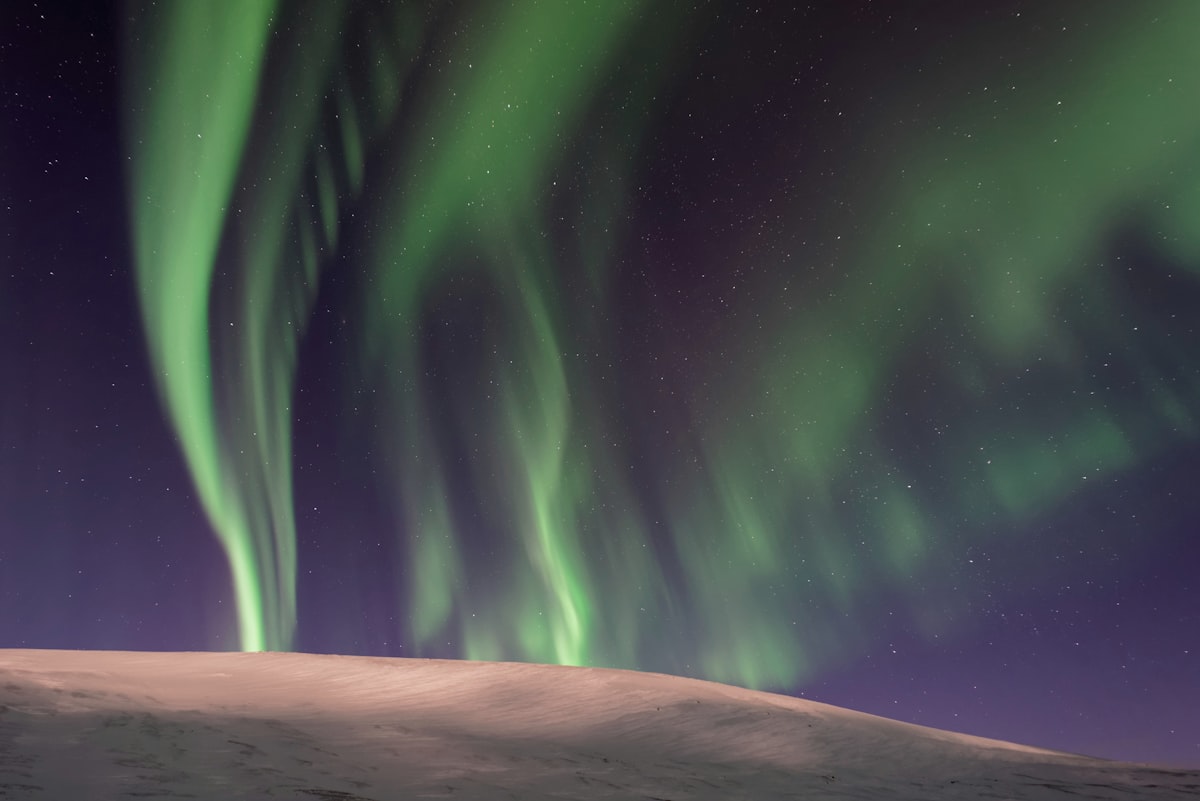
Ask an Icelandic photographer where they go when they are serious about the northern lights, and a surprising number will say the same thing: the Mývatn area. The lake and the country around it, out toward Húsavík on the north coast, sit in one of the darkest and statistically clearest corners of Iceland — and the foregrounds here, twisted lava and rising geothermal steam, are unlike anywhere else on the island. This is a guide to aurora hunting in North Iceland’s Diamond Circle, and how to pick the one clear night that makes the long drive worth it.
Why Mývatn is called Iceland’s aurora capital
Two things decide whether you see the aurora on any given night: darkness and clear sky. Lake Mývatn scores unusually well on both.
On darkness, it is genuinely remote. There is no city glow for tens of kilometres in any direction — the nearest real town, Akureyri, is an hour to the west behind a mountain pass. On a moonless night the sky over the lake is as black as it gets in inhabited Iceland, which means even a modest Kp 2 to 3 aurora reads as a clear green arc rather than getting washed out.
On weather, the north sits in a partial rain shadow. Most of Iceland’s wet Atlantic systems roll in from the south and west and dump their cloud on the south coast before they ever reach the interior of the north. Mývatn is not immune to cloud — nowhere in Iceland is — but night for night it tends to see more clear breaks than Vík or Reykjavik on the same weather map. Combine dark and comparatively clear and you have why the area earns its “aurora capital” reputation.
Where to stand around the lake
Mývatn is not one viewpoint but a whole shoreline, so you have room to chase a clear patch of sky:
- Dimmuborgir — the “dark castles,” a field of black lava pillars and arches on the lake’s east side. Framing an aurora between the lava towers gives you a foreground you cannot photograph anywhere else on Earth. Stick to the marked paths; the lava is sharp and the ground uneven in the dark.
- The Reykjahlíð shore and Höfði — open lakeside stretches on the north and east give you a wide, low horizon and, on a still night, the lights mirrored in the water.
- The Hverir geothermal field at Námafjall, just east over the ridge, adds rising steam vents lit from below — surreal under a green sky, though the sulphur smell is not for everyone.
Each of these has its own live score in our app, so you can see which side of the lake is clearest before you commit.
The Diamond Circle: build a whole aurora night around the drive
Most people reach Mývatn as part of the Diamond Circle, the northern road-trip loop that strings together four landmarks — and every one of them doubles as an aurora foreground:
- Goðafoss, the “waterfall of the gods,” 40 minutes west of the lake and an easy roadside stop with a broad dark sky.
- Dettifoss, Europe’s most powerful waterfall, to the east — dramatic but exposed, so mind the ice and spray after dark.
- Húsavík, the whale-watching town on the north coast, where a dark working harbour, the wooden church, and open sea to the north make a quietly beautiful aurora scene. As a base it also has hotels and food, which the lakeside does not have much of.
Doing the loop by day and staking out one spot after nightfall is the ideal north-Iceland aurora plan. If you are coming up from the capital first, our Akureyri and North Iceland guide covers the gateway city and the shorter drives from there.
The honest catch: getting here
The trade-off for all this dark, clear sky is reach. Mývatn is about five to six hours by road from Reykjavik, or a 45-minute domestic flight to Akureyri followed by an hour’s drive. This is not a spontaneous evening trip from the capital — it is a region you commit a couple of nights to. That is exactly why timing matters so much: with only two or three nights in the north, you cannot afford to drive out under cloud on a whim.
This is where live, spot-level data earns its place. We score every northern spot every five minutes against real cloud observations from vedur.is weather stations, so instead of trusting a national forecast you can see that Mývatn is socked in but Húsavík, 45 minutes north, has a clear window opening — and go there instead. For how the numbers behind the score fit together, see how to read an aurora forecast, and for when in the year to plan the trip, our best time to see the northern lights in Iceland guide breaks the season down month by month. Remember the north follows the same calendar as the rest of the country: the aurora season runs late August to mid-April, and the midnight sun makes viewing impossible from May through July.
Before you set out across the Diamond Circle tonight, open the Aurora Iceland app or the Tonight page. It will tell you which corner of the north — the lake, the lava, or the coast — has your clearest sky right now.