The Honest One-Line Answer
Yes — it is possible to see the northern lights from the Blue Lagoon. But it is one of the weaker places on the Reykjanes peninsula to try, and if the aurora is the reason you booked the evening slot, you are setting yourself up for a let-down.
We score the Blue Lagoon as one of our 100+ Icelandic viewing spots, every five minutes, all season. Our own data rates its light pollution as medium. Ten to twenty minutes away, Garðskagi Lighthouse and the Bridge Between Continents both rate low. That gap is the whole article. The lagoon is a wonderful place to spend an evening — it is simply not a dark-sky site, and the marketing around it tends to blur that line.
Three Things Working Against You in the Water
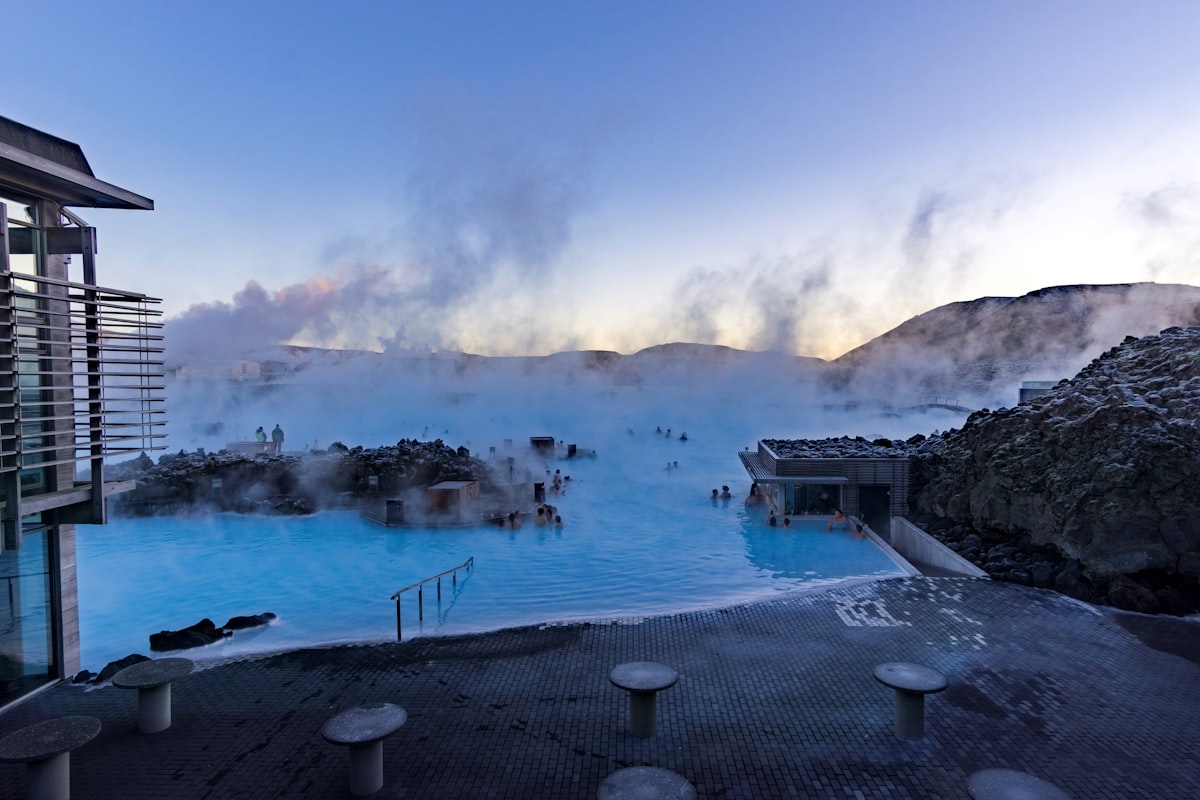
The lagoon is lit, on purpose. It is a spa operating after dark, so the water, the paths, the bar, and the walkways all carry safety and architectural lighting. The lagoon does dim things down when a display is underway, and that helps — but “dimmed” is not “dark.” A strong aurora will punch through easily. A faint one, which is what most nights actually deliver, will not.
The steam is not your friend. The thing the Blue Lagoon is famous for is the thing that hurts you here. Warm vapour drifting off 38°C water sits between you and the sky, scattering the light around you and softening whatever contrast a faint arc has left. A pale grey band low on the horizon is exactly the sort of display that vapour erases.
You cannot dark-adapt in a spa. Your eyes need roughly 15–20 minutes of genuine darkness before they resolve faint aurora, and a single glance at a phone or a lit bar resets that clock. Between the lighting, the people, and the drink in your hand, the lagoon is about the least likely place in Iceland for your night vision to ever switch on. If you are unclear on why that matters so much, our guide to what the aurora actually looks like to the naked eye explains the biology — most nights it is grey, not green, and grey is precisely what gets washed out first.
The Timing Problem Nobody Mentions
Here is the detail that decides it, and we have not seen a single tour operator page state it plainly.
Through the heart of aurora season — roughly August 21 to January 31 — the Blue Lagoon is open 08:00 to 22:00, guests are asked to leave the water 30 minutes before closing, and the last entry slot lands somewhere around 20:00–20:30. So your time in the water ends at about 21:30.
Now put that against the sky. Aurora activity tends to peak around magnetic midnight, broadly 22:00 to 01:00 — the window we walk through in the best time of night to see the northern lights. Your soak ends almost exactly when the best part of the night begins.
Read that as scheduling advice rather than bad news. The lagoon and the aurora are not competing for the same hours; they are sitting neatly back to back. Book an evening slot, get out at 21:30, and drive fifteen minutes to real darkness with the entire peak window still ahead of you. That is a genuinely great night. It is only a disappointing one if you expected the lagoon itself to deliver the show. (Hours shift by season and the lagoon adjusts for conditions — always confirm on the day.)
Where to Go Instead, Ten Minutes Away
You are already on the darkest peninsula within easy reach of Keflavík. Three options, all free, all paved:
- Bridge Between Continents — the closest genuine dark-sky pivot from the lagoon, a free car park off Route 425, open lava plain, horizon in every direction, and almost nothing to throw stray light.
- Garðskagi Lighthouse — the peninsula’s north tip, free parking, unobstructed Atlantic horizon north and west, and only ten minutes from the airport if you are flying out.
- Grindavíkurvegur — a paved 24-hour pull-off on Route 43, the nearest dark stretch to the lagoon itself. No services or shelter, and it sits near the Sundhnúkur fissures, so check road.is for closures first.
One standing caveat for the whole area: access around Svartsengi and Grindavík can change with seismic or volcanic activity. The lagoon closes at the start of an eruption and reopens once authorities have assessed it, and it has done that several times since 2023 without much long-term disruption. Check bluelagoon.com/seismic-activity and safetravel.is before you commit to a plan built around this corner of Reykjanes.
Check the Score Before You Soak
The move is simple: look at tonight’s numbers before you book the evening slot, not after you have towelled off. If our live aurora forecast is showing Good or Excellent for the Reykjanes spots and the sky is clear, plan the drive out to Garðskagi or the Bridge for 22:00 and treat anything you catch from the water as a bonus. If it is showing Low, enjoy the lagoon for exactly what it is — one of the best warm evenings in Iceland — and hunt another night.
The Aurora Iceland app scores all 100+ spots every five minutes using real cloud observations, so you can compare the lagoon against the dark spots down the road and see the difference for yourself. If you are working with a tight connection rather than a full evening, our Keflavík layover guide lays out how much time you actually need.