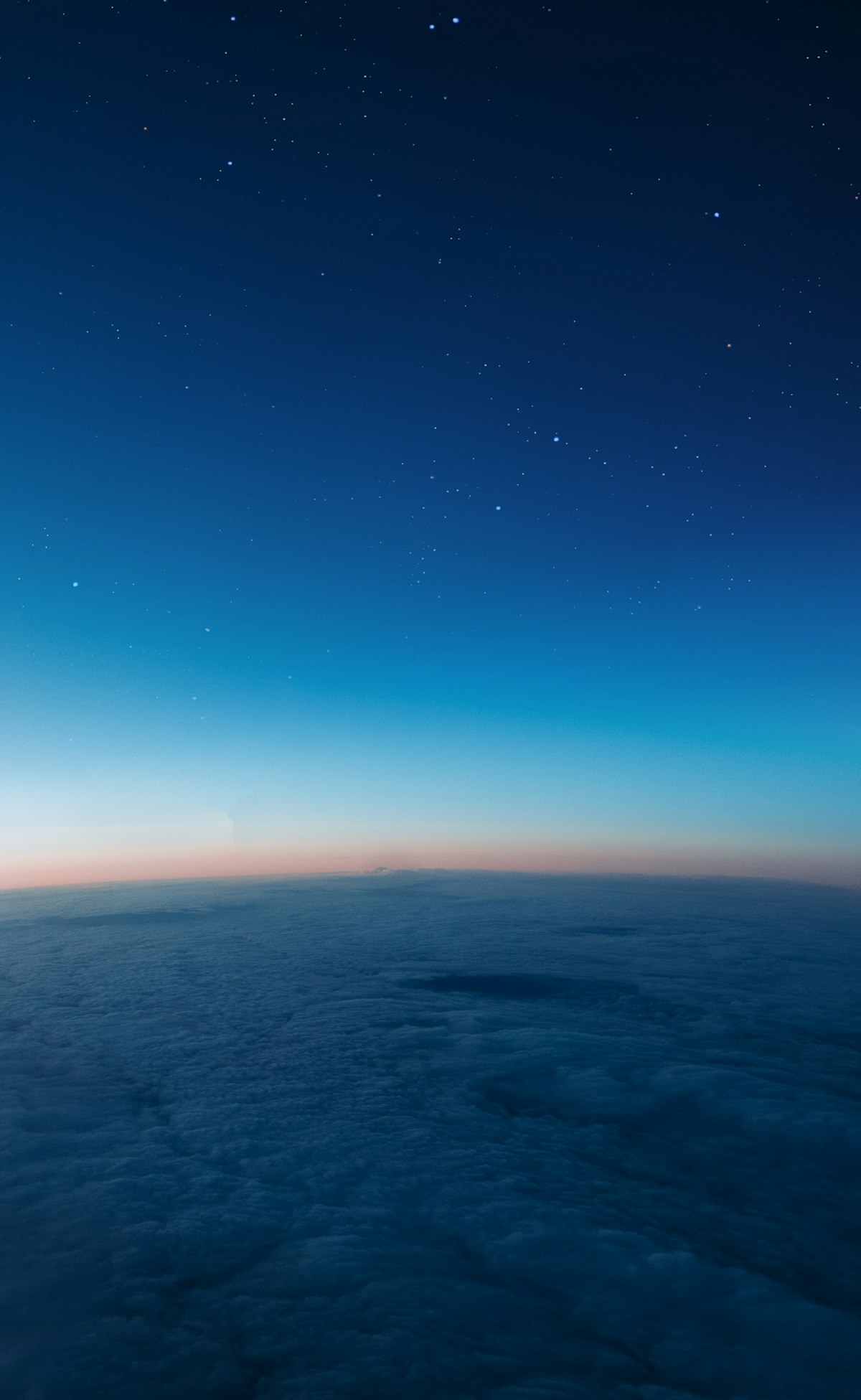
This is the first aurora question you can still do something about. Where you stand and which night you go out are decided after you arrive; the window seat is decided before you board, and almost nobody tells you which one to book.
So here is the answer, worked out for the routes that actually fly to Keflavík rather than for aviation in general.
Yes, and Altitude Is a Real Advantage
At cruise you are above every cloud layer. Cloud, not solar activity, ends most Icelandic aurora nights — so a flight removes the single biggest limiting variable in the hobby. There is no light pollution at 38,000 feet either.
You also see further. The aurora sits at roughly 100 km altitude, and a 100-km-high object stays above the horizon out to about 1,120 km at sea level and 1,500 km from a cabin window — an extra 384 km of reach in every direction. A display too far north to be seen from Reykjavík can still be in view from your seat.
Which Side of the Plane Faces North
This is the whole question, and the generic answer — “the side facing the pole” — is useless when you are staring at a seat map. It depends on your direction of travel, so we computed the great-circle heading along each route.
Flying from North America, sit on the LEFT. The track from Boston or New York runs east-northeast the whole way: a heading of about 34 degrees at departure, opening to roughly 72 degrees on the approach to Keflavík. North stays on the port side from take-off to landing.
Flying from the UK or continental Europe, sit on the RIGHT. London to Keflavík runs about 326 degrees down to 308; Copenhagen about 310 down to 281. You are heading northwest, so north is on the starboard side.
The short version: flying east to Iceland, sit left. Flying west to Iceland, sit right.
On the 3-3 cabins that operate most Iceland routes, the left-hand window is seat A and the right-hand window is seat F. On a widebody the letters change, and a few rows on any aircraft have a misaligned or missing window — worth checking a seat map before you pay to choose.
The Overnight Is the Better Flight, Not the Compromise
The usual assumption is that the short evening hop from Europe is the easy win and the transatlantic redeye is something to endure. Our arithmetic says the opposite.
We ran the sun’s altitude along each route, minute by minute, and counted how much of the flight sits in genuine astronomical darkness as seen from the cabin:
| Date | Transatlantic overnight (5h30) | European evening hop (3h05) |
|---|---|---|
| Late August | ~2 h | none |
| Early September | ~3 h | none |
| Late September | ~4 h | none |
| Mid October | ~5 h | ~3 h |
| November to February | the entire crossing | ~3 h |
| Mid March | ~4 h | ~1.5 h |
| Mid April | ~3 h | none |
From mid-October to February the North Atlantic crossing is dark essentially gate to gate, with the sun 50 degrees below the horizon at the midpoint. That is more continuous darkness than you will get on any night on the ground in Iceland.
The short European hop is the fragile one, because three hours is not much and the clock decides everything. A departure around 21:30 is dark for the whole flight across the season; the same route leaving at 19:30 is dark only from October to early March; and an early-evening departure never gets dark at all. If you are flying in from Europe in September, check your departure time before you pay for a window.
What Altitude Takes Away
One honest caveat, because it runs the other way. From 38,000 feet the horizon is depressed by 3.45 degrees — you are looking slightly down at it — so the sun has to sink that much further before the sky goes properly dark. At Icelandic latitudes the sun moves slowly at those depths, and that 3.45 degrees costs about 68 minutes of true darkness compared with the ground below you, split between dusk and dawn.
It matters most at the edges of the season, exactly where the table above thins out, and is irrelevant in midwinter.
What Actually Ruins It Is the Cabin
Cloud will not spoil your view. The cabin will.
- Kill the light on your side. Your own reading light, your screen, and the seatback screen in front of you all reflect straight off the window.
- Cup your hands against the glass. This single move does more than anything else on the list. It blocks the cabin reflection and lets your eyes see the actual sky.
- Give it fifteen minutes. Dark adaptation is slow, and a glance out of the window straight after a film will show you nothing.
- Know what you are looking for. From a plane a moderate aurora reads as a pale grey-green arc, not the saturated green of photographs — the same as from the ground, and worth reading up on in what the northern lights actually look like to the naked eye.
Before You Land
If you see it from the plane, that is a bonus rather than a plan. The trip still gets decided on the ground, so the useful thing to do on the descent is check when the darkness window actually opens for your dates.
If your stop is short, our guides to an aurora hunt from a Keflavík layover and making a single Reykjavík night count cover the ground from the terminal onward.
Check the Tonight page for a live score on all 137 spots before you land, or put the Aurora Iceland app on your phone while you still have airport wifi. Then take the left-hand seat, turn your screen off, and look north.