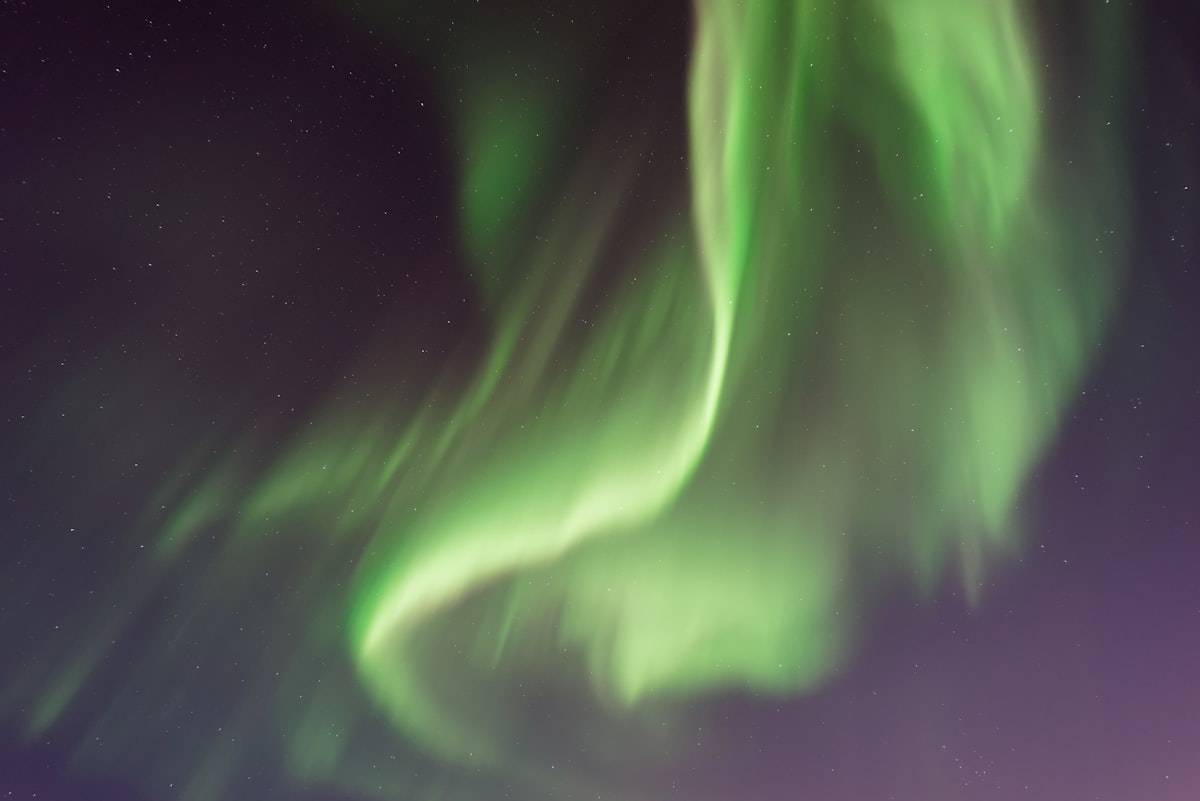
Ask when aurora season starts in Iceland and almost every answer says the same thing: “late August or early September.” That is not wrong, but it is not a date, and it is useless if you are choosing between a trip on 22 August and a trip on 8 September.
Aurora season does not start when the lights switch on. They are already there, all summer, invisible above a sky that never gets dark. The season starts when the darkness comes back, and darkness has an arrival date you can calculate to the minute. Here are the real ones.
The North Goes Dark Last, Not First
Start with the part that catches almost everyone out, including plenty of guides written in Iceland.
The standard advice is to head north for the aurora, because the north sits closer to the auroral oval. Through the winter, that is sound. In August and early September it is backwards, because at this time of year higher latitudes hold on to their twilight longer: the further north you stand, the shallower the path the sun takes below the horizon, so the less far down it gets. Reykjavík is dark before Akureyri is. The south coast is dark before either.
For a trip in the second half of August, this quietly reverses the usual recommendation: the south coast is the right call, and it is dark more than a week before the Westfjords are.
The same reversal holds between countries, not just within Iceland. Tromsø, five degrees further north, does not get its first astronomical night until the middle of September — a fortnight after Reykjavík. We ran the numbers for both in Iceland or Tromsø for the northern lights.
The Actual Dates
All dates are for 2026. Iceland stays on GMT year-round with no daylight saving, so local time needs no conversion.
| Where | First usable dark window | True astronomical night |
|---|---|---|
| Vík / south coast | 13 August | 31 August |
| Reykjavík | 16 August | 2 September |
| Akureyri | 21 August | 6 September |
| Ísafjörður | 22 August | 8 September |
That is a nine-day spread across a country you can drive across in a day — wide enough to decide where you sleep, not just which week you fly. The ordering also reverses later in the season: Ísafjörður goes dark last in August but overtakes Reykjavík on total darkness in early November, which is the planning problem our Westfjords guide works through.
One caveat: the first night in either column is a technicality more than an opportunity. Reykjavík’s window on 16 August is about an hour long and sits squarely in the middle of the night. These are the dates the sky permits a sighting, not dates anything is promised.
Two Kinds of Dark, and Why It Matters
Most guides use “dark” as though it were a single state. It is worth separating, because the two tiers decide what you can actually see.
Nautical twilight is the sun 12 to 18 degrees below the horizon. This is what late August delivers. It is dark enough that a genuine display reads clearly — a real green arc stands out against it — and not dark enough for the faint stuff, which stays lost in the residual glow.
Astronomical night is the sun a full 18 degrees down: properly dark, with faint arcs back in range. This is the column on the right in the table above, and the honest headline is that it does not happen anywhere in Iceland in August except on the south coast, and there only on the last night of the month.
So both answers to “when does the season start” are defensible. Mid-to-late August is when it becomes possible; early September is when it becomes reliable. Anyone giving you a single date has collapsed the distinction that decides whether a quiet night shows you anything at all. Our August guide walks through the window night by night, and the September guide picks up where real darkness begins.
This Week Is a Perfect Illustration
This week is an unusually clean example of why darkness, not activity, is the gate this time of year.
NOAA’s three-day forecast issued this morning puts the greatest expected Kp for 17 to 19 August at 4.00 — elevated, below storm level, and the sort of number that gets screenshotted and shared as an alert. Look at when those peaks land. The Kp 4 slot on 17 August falls between 09:00 and 12:00: late morning in Iceland, with sunset not until 21:39. The second, early on 18 August, runs 03:00 to 06:00. Reykjavík’s dark window that night closes at 02:27 — the peak arrives after the sky has started brightening again.
A Kp 4 night is a real event in Scotland or Scandinavia. In Iceland this week, it is worth nothing, and no Kp dial on any app will tell you that. Meanwhile 19 August, which longer-range outlooks had flagged as the strongest day of the month, has since been revised down to a maximum of 1.67 — a useful reminder of how far ahead an aurora forecast is actually worth reading.
So When Should You Come?
Three things have to stack: darkness, a dark moon, and activity. Only the first two can be known in advance, and they point at the same window.
Astronomical night returns to Reykjavík on 2 September, but a full moon on 28 August sits directly on top of the only late-August nights with usable darkness. New moon follows on 11 September, with the moon under 10 percent lit from 8 to 13 September. That makes roughly 8 to 13 September the first genuinely dark, moonless stretch of the season — the earliest point at which the predictable pieces line up. Our guide to the moon and Iceland’s darkest nights has the full season’s dates.
Before then, if you are already here, go south. Vík has had a usable window since mid-August. Akureyri is worth the drive in October and not in the third week of August, whatever the general north-versus-south case — which we argue properly in north Iceland vs south Iceland.
Know the Night It Actually Opens
The first real night of the season arrives without announcement, and it depends on where you are standing. Our live aurora forecast scores every monitored spot in Iceland every five minutes on darkness, cloud and activity together, so a bright Kp number over a twilit sky does not read as a good night. The Aurora Iceland app does the same on your phone and can alert you when conditions actually cross the line near you.
Season start is a gradient, not a date. But the gradient has numbers, and now you have them.