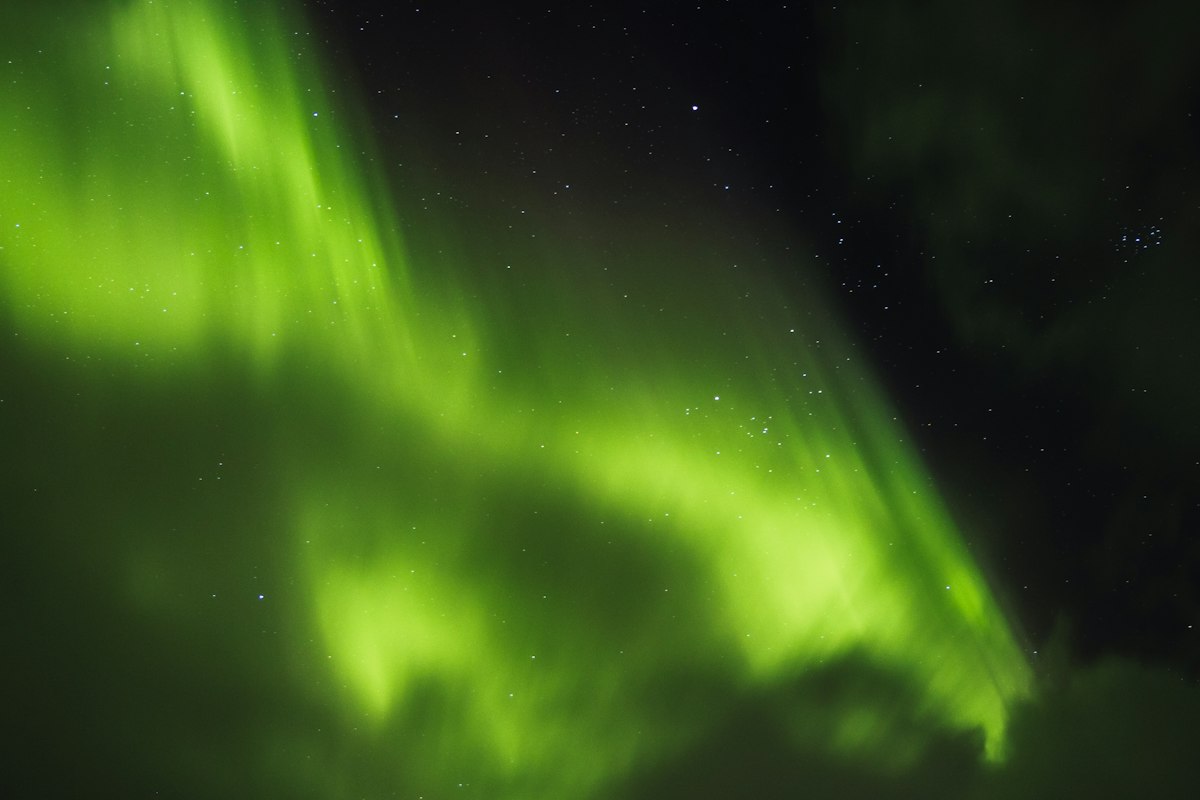
The Short Answer: It Doubles the Storms, Not the Average Night
Every March and September, travel sites and tour pages repeat that the equinox doubles your chances of seeing the northern lights. It is half right, and the half that is right matters if you are choosing when to go to Iceland.
We checked it against the planetary Kp record kept by GFZ Potsdam, which runs from January 1932 to this week: more than 270,000 three-hour readings. Compare the four equinox months (March, April, September, October) with the four around the solstices (June, July, December, January):
- Storm-level periods (Kp 5- or higher, roughly NOAA G1) are 1.95 times as common around the equinoxes.
- The average Kp is only 1.16 times higher.
So the equinox does double something: the storms, not the typical night. What changes is how often a strong night turns up.
What 94 Years of Kp Data Show
Here is the share of three-hour periods at storm level, month by month, from 1932 to September 2026:
| Month | Storm-level share | Mean Kp |
|---|---|---|
| March | 9.47% | 2.39 |
| September | 9.44% | 2.35 |
| April | 9.24% | 2.36 |
| October | 9.10% | 2.27 |
| February | 6.93% | 2.25 |
| November | 6.40% | 2.09 |
| June | 5.28% | 2.05 |
| January | 4.51% | 2.05 |
| December | 4.05% | 1.94 |
Two things stand out that the usual line leaves out.
The stronger the storm, the bigger the equinox advantage. Periods at Kp 4- or higher are only about 1.5 times as common around the equinoxes as around the solstices. At G1 the ratio is 1.95, at G2 it is 2.3, and at G3 it is 2.5. Compared month to month, a G3-level period is almost seven times as common in September as in December. The equinox barely changes moderate activity. Its effect is on the big displays.
It is a season, not a date. Nothing special happens on the day of the equinox itself. Split into ten-day blocks, the storm share is 8.0%, 9.2% and 11.1% through September, then 9.6%, 8.5% and 9.2% through October, and the drop only comes in November (7.5%, then under 6%). March and April follow the same pattern. The boost covers roughly six weeks either side of each equinox, which is why our October guide treats the whole month as equinox season.
Looking at it night by night gives the same result. Counting the six hours from 21:00 to 03:00 UTC, when Iceland’s aurora is usually at its best, 14.7% of September nights in the record include at least one storm-level period, against 6.7% of December nights. That is how often storm-level activity happened. It is not your chance of seeing aurora on a given night, which depends mostly on cloud and the moon.
Why It Happens: The Russell-McPherron Effect
Aurora gets strong when the magnetic field carried by the solar wind points southward relative to Earth’s own field. That lets the two fields connect and pour energy into the magnetosphere. In 1973, Christopher Russell and Robert McPherron showed that geometry alone tilts the odds with the seasons. The Sun’s field arrives lying mostly along the Sun’s equatorial plane, and Earth’s magnetic axis is tilted against that plane in a way that changes through the year. Around the equinoxes, part of that sideways field ends up pointing south from Earth’s point of view, so the same solar wind couples more strongly.
It is not the whole story. At the equinoxes Earth’s magnetic axis is also square-on to the solar wind, and researchers still debate how much of the seasonal pattern each effect explains. Either way, the pattern is physical and repeats every year.
What It Means for an Iceland Trip
This is where Iceland differs from most places that repeat the claim. Iceland sits under the auroral oval, so you rarely need a storm. Aurora is regularly visible at Kp 2 to 3 when the sky is dark and clear. In mid-September 2026, people using our app photographed aurora on four separate nights at an estimated planetary Kp between 1.67 and 3.33, and the faintest of them came on the most active night. We explain why Kp alone is a weak guide in how to read an aurora forecast.
So the equinox changes less for an Iceland trip than the headline suggests:
- It raises the chance of a big night, not of seeing anything at all. If you have dreamed of a sky-filling, fast-moving display, March, April, September and October really do give you about twice the chance. If you would be happy with a green arc, darkness and cloud matter far more.
- Cloud does not follow the equinox. Reykjavík’s long-term average is 5.7 to 6.1 octas of cloud in every month of the year, so spring and autumn skies are no clearer than winter ones.
- The moon can cancel it. A bright moon washes out exactly the faint, ordinary displays that make up most Iceland sightings. Check the moon-free darkness calendar before you pick dates, whichever season you choose.
- December has the lowest storm odds but the most darkness. It is the least stormy month in the record, but it has the longest nights. Neither season wins on every count, so pick the one that suits your trip.
Equinox Week 2026: A Live Example
The autumn equinox falls at 00:05 on 23 September 2026, Iceland time (the next one is 20 March 2027 at 20:25). This year it shows both halves of the argument. NOAA’s forecast issued on 21 September expects nothing above Kp 2 through the 23rd and says that “no significant transient or recurrent” solar wind features are forecast. The long-term statistics are real, but the equinox itself can still be completely quiet. The boost is a better chance over weeks, not something that happens on a set date. It also has nothing to do with the solar cycle’s slow decline, which we cover in Solar Cycle 25 after the peak.
Plan Around the Night, Not the Date
Treat the equinox as a bonus in the right season, not a reason to fly on a particular day. Once you are in Iceland, what counts is tonight’s darkness, cloud and solar wind together. The live aurora forecast scores all of those for 137 viewing spots every few minutes, and the Aurora Iceland app puts the same score in your pocket so you know when it is worth heading out.