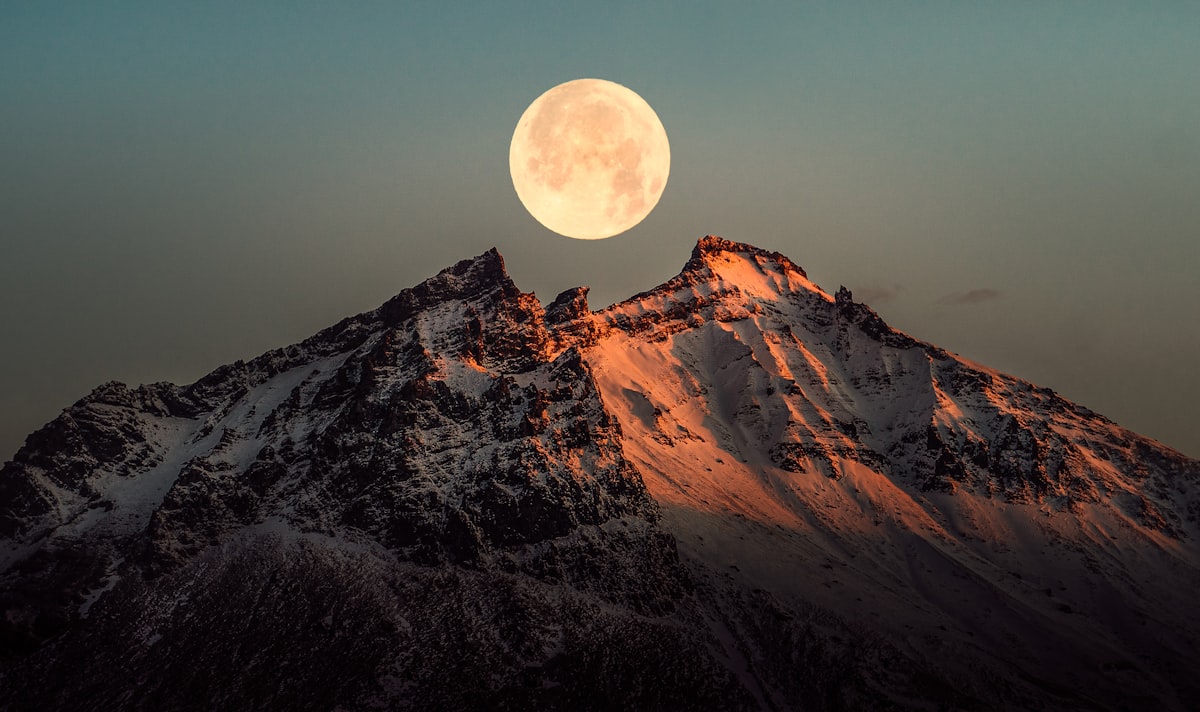
The Short Answer: Plan Around the Moon, Never Cancel For It
If you have any flexibility about which week you come to Iceland, book the new moon week. It costs you nothing and it buys you the darkest sky of the month.
If you do not have that flexibility, stop worrying. A full moon dims faint aurora. It does not stop a real display. A strong substorm cuts through moonlight the way a streetlight cuts through dusk.
What Moonlight Actually Does
The aurora does not care about the moon. Your eyes do.
A display has a fixed brightness. What changes is the background it has to stand out against. A full moon lifts the brightness of the whole sky, and that swallows the faintest structure first: the thin grey-green arc low on the northern horizon, the delicate vertical rays, the colour that only registers once your eyes have fully dark-adapted.
So it attacks the bottom of the range, not the top. A Kp 2 night that would have shown a soft arc under a new moon may show nothing under a full one; a Kp 5 night looks broadly the same either way. Since most Icelandic nights are quiet nights, the moon costs you most on exactly the nights you were already going to be squinting — which is what a real aurora looks like to the naked eye most of the time.
The Moon Is Fourth on the List
Ranked by how much damage each can do to an Icelandic night:
- Cloud cover. Total veto. No amount of geomagnetic activity survives an overcast sky.
- Darkness. From April 9 to September 1 there is no astronomical night at all in Reykjavík, and moon phase is irrelevant — the sky is the limiting factor, not the moon.
- Light pollution. Driving 40 minutes out of Reykjavík buys more contrast than any moon phase takes away.
- The moon.
- Kp. Last, because it is the one thing you cannot change by moving.
That order is roughly how our own scoring weights these inputs across 137 Icelandic locations, and it is why we score individual spots rather than publish one national number — the same point our guide on how accurate the aurora forecast really is makes about cloud being the harder forecast.
If you are choosing between a new-moon week at a Reykjavík hotel and a full-moon week at a dark rural base near Þingvellir, take the rural base. It is not close.
The Darkest Nights of the 2026-27 Season
All dates below are Iceland local time, which needs no conversion: Iceland stays on GMT year-round with no daylight saving. The dark window is roughly the five nights either side of a new moon.
| Month | New moon (darkest) | Best dark window | Full moon |
|---|---|---|---|
| September 2026 | Sep 11 | Sep 6-16 | Sep 26 |
| October 2026 | Oct 10 | Oct 5-15 | Oct 26 |
| November 2026 | Nov 9 | Nov 4-14 | Nov 24 |
| December 2026 | Dec 9 | Dec 4-14 | Dec 24 |
| January 2027 | Jan 7 | Jan 2-12 | Jan 22 |
| February 2027 | Feb 6 | Feb 1-11 | Feb 20 |
| March 2027 | Mar 8 | Mar 3-13 | Mar 22 |
| April 2027 | Apr 6 | Apr 1-11 | Apr 20 |
One note on the edge of the season: the first genuinely dark nights of 2026, arriving in the last third of August, fall under a brightening moon that reaches full on 28 August. The season does not reopen on a dark-sky week — the first of those is the second week of September.
The “best dark window” column above is a phase-based shorthand, and the next two sections explain why altitude beats phase whenever the two disagree. September 2026 is the clearest example in the table: run the moonrise and moonset times against the actual dark window and the best nights of the month come out as 14-20 September, later than the new-moon column alone would suggest, because a waxing moon sets before astronomical night even begins. Our September 2026 guide works that month through night by night.
A piece of trivia that doubles as a mnemonic: August’s new moon fell on 12 August 2026, which is exactly why the total solar eclipse happened that day — an eclipse can only occur at new moon, the one time the moon sits between us and the Sun. Find a solar eclipse date and you have found a dark aurora week.
The Winter Full Moon Problem Nobody Mentions
Here is the part the lunar calendars leave out, and it is specific to how far north Iceland sits.
A full moon is by definition opposite the Sun, so it traces the path the Sun would trace six months away. In December, when Iceland’s sun barely clears the horizon, the full moon behaves like a June sun: it climbs high, and at 64°N it stays up for close to twenty hours. A midwinter full moon is therefore the worst case there is — high, up essentially all night, with snow on the ground bouncing the light back at you.
The flip side is more useful. Outside that midwinter peak the moon rises and sets, and in the days after a full moon it rises progressively later — so a waning gibbous week still hands you several properly dark hours early in the night. The phase is a headline; the moonrise and moonset times are the real schedule, and they often leave the 22:00 to 01:00 substorm window partly or entirely moon-free. Check the setting time before writing a night off.
The reverse case is worth seeing worked through, because it is what a genuinely bad night looks like. When the season’s first G2 storm arrived on 27-29 August 2026, the full moon rose before the sky darkened and set after it brightened again — staying above the horizon for the entire dark window on all three nights, and leaving Reykjavík, Vík and Akureyri alike with not one moon-free dark minute to watch it in.
When a Bright Moon Is an Asset
Ask a landscape photographer and you get a different answer. An unlit Icelandic foreground at new moon is a black silhouette; under a half or gibbous moon the mountains, snow and water are all lit, and a single exposure can hold both a green sky and a visible landscape.
If you want to see the faintest possible aurora with your own eyes, take the new moon. If you want a photograph worth hanging on a wall, a quarter moon is arguably the better night.
How to Use This
Pick your week around the new-moon dates above if you can. Then forget about the moon and put your attention where it belongs: on cloud cover, on getting away from town, and on staying out past midnight. The Kp index and OVATION explainer covers the numbers, and how many nights you need covers the only variable that reliably improves your odds.
On the night itself, the moon is already baked into the decision. Check the live per-spot scores on our Tonight page or in the Aurora Iceland app, which reads live cloud observations from Icelandic weather stations and tells you which location is worth the drive right now. A full moon has never been a reason to stay indoors. A thick deck of cloud always is.