Search for glass igloos in Iceland and you will find ranked buy-lists, almost all written to earn a booking commission. None of them answers the question people are actually asking, which is not “which one is prettiest” but “will this make me more likely to see the northern lights?”
Our answer: a bubble or glass igloo is an experience purchase, not an odds purchase. If that is what you are buying, it can be a wonderful night. If you are booking it because you think a glass roof improves your chances, you are paying a premium for the opposite.
A Glass Roof Is One Fixed View of One Patch of Sky
Aurora hunting in Iceland is a repositioning problem. Solar activity is roughly the same over the whole country on any given night; cloud is not, and cloud is what decides most nights. That is the entire premise behind scoring 137 spots across 14 regions separately instead of publishing one national number.
A dome sells you the opposite of that flexibility. You have booked one location, months ahead, on a night whose weather nobody could have known. If cloud parks over your dome you are watching the underside of a cloud deck through expensive glass, with no way to drive forty minutes to the clear band. Everyone else can move. You have paid extra not to.
On a typical Icelandic night the clear sky is somewhere, just not everywhere, and the difference between a good night and a wasted one is usually a short drive — which is what our guide to what to do when it is cloudy is built around.
The Trees Are in the Wrong Place
This is the point nobody in the buy-lists makes, and it comes straight from the operators’ own marketing.
The Buubble properties describe each bubble as sitting “in its own clearing in the evergreen forest, private and screened by the trees.” That screening is a genuine feature — it is what makes the bubble private enough to sleep in. It is also, for aurora, a problem.
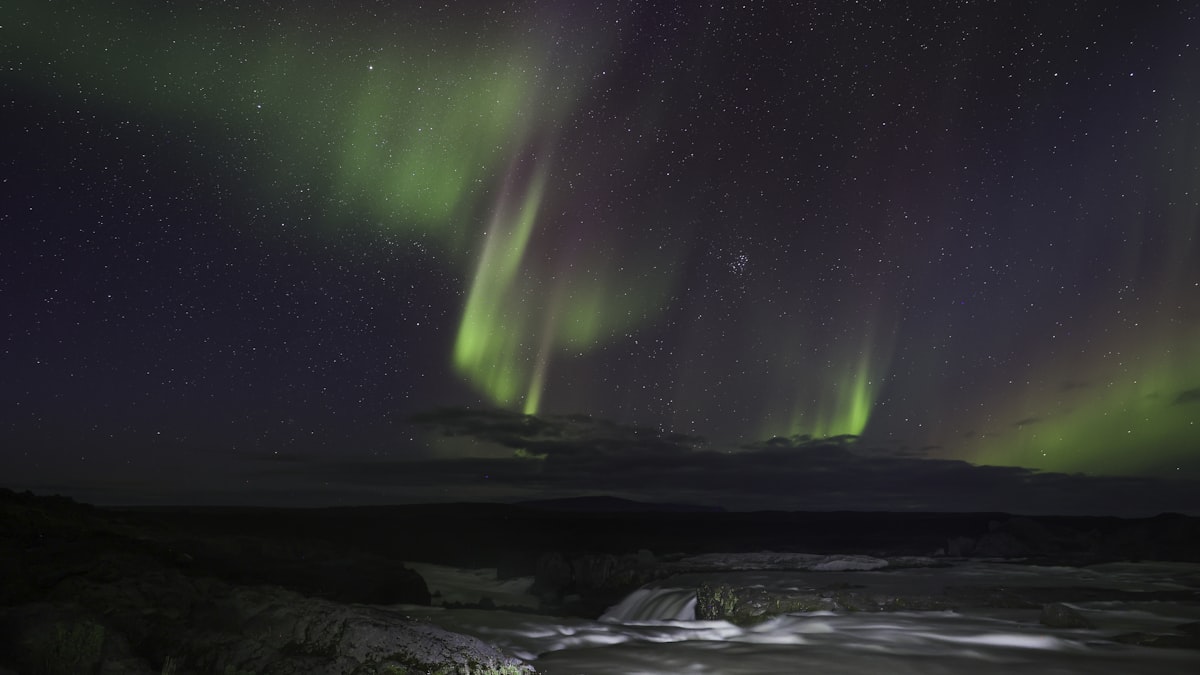
The aurora appears from Iceland as a low arc along the northern horizon, and on the moderate nights that make up most of the season it never climbs much higher. A domed roof sells you the zenith. At the activity levels you will most likely get, the display is not at the zenith; it is down at the treeline, which is exactly where the trees are. Compare that with somewhere like Grótta or the open plains around Hella, where nothing stands between you and the north.
Panorama Glass Lodge’s own site adds a second warning, and an unusually honest one for an operator to publish: “there will be light from the sun or moon if it’s fullmoon and we recommend to bring your sleeping masks.” A full moon washes out a faint display whether you are under glass or not. Check the moon phase before you book a date — that is one variable you genuinely can control months ahead.
What They Actually Get Right
If the piece stopped there it would be sour grapes, so here is the other side.
Comfort is a real advantage, not a soft one. Aurora watching in an Icelandic winter means standing outside in wind at -5°C for hours, and most people stop before the display arrives. Being warm and horizontal genuinely extends how long you last. The heated-glass designs the category advertises — a heating element laminated into the panel, keeping the surface just above freezing so frost and snow never settle — solve a real problem that ruins ordinary windows. Confirm it for the property you book, though: not every Icelandic dome advertises heated glass.
The location premium is also smaller than it looks. Buubble’s two sites, Hrosshagi near Reykholt and Ölvisholt near Selfoss, start from around €229 a night at the time of writing and sit an hour to ninety minutes from Reykjavík — genuinely dark, genuinely rural. Check the practical details first, though: at Buubble the bathroom is a shared service house 30 to 50 metres away, which is a different proposition at 3am in February than it looks in a photograph.
The Feature That Matters Most Is the One Bubbles Rarely Offer
The single feature that most improves your chances on a given night is someone waking you up when it starts. Nobody can stay awake watching an empty sky from 9pm to 3am. Something has to trigger.
That feature is a hotel feature, not a glass-roof feature. Hotel Rangá’s aurora wake-up button on the in-room phone is the well-known example, and it is one of the reasons it ranks in our top ten places to stay for the aurora. But we checked the sites of the best-known bubble and glass properties, and neither Buubble nor Panorama Glass Lodge advertises a wake-up service at all — even where third-party directories claim that “all” glass igloos have one. The implicit pitch is that you do not need waking because you are already looking at the sky. You are not. You are asleep.
The good news is that this is the one feature you can replicate for free, anywhere in the country. That is what our alerts do, and they fire on the score for the spot you are actually standing in rather than on a national Kp number — the reasoning is in our aurora app comparison.
So Should You Book One?
Book one if the night itself is the point. It is a memorable, genuinely lovely thing to do, and if the aurora shows up it will be spectacular. Treat any display as a bonus and you will not be disappointed.
Do not book one if your goal is maximising your chance of seeing the aurora. For that money, a cheap rural base plus a rental car wins, because you can move and the bubble cannot. Our dark-sky base guide covers how to choose one, and how many nights you actually need is the more important budget question anyway.
The middle path most people miss: book the bubble for one night as the experience, and stay somewhere flexible for the rest of the trip. For the warm-and-comfortable version without the fixed-location penalty, a geothermal pool under the aurora gets you most of the way there for a fraction of the price — and you pick which one on the night.
Whatever you book, set expectations from what the aurora looks like to the naked eye rather than from a long-exposure photograph of a glass dome. Then check the live forecast for tonight before committing to a location, and let the Aurora Iceland app tell you when it is worth getting out of bed — under a glass roof or not.