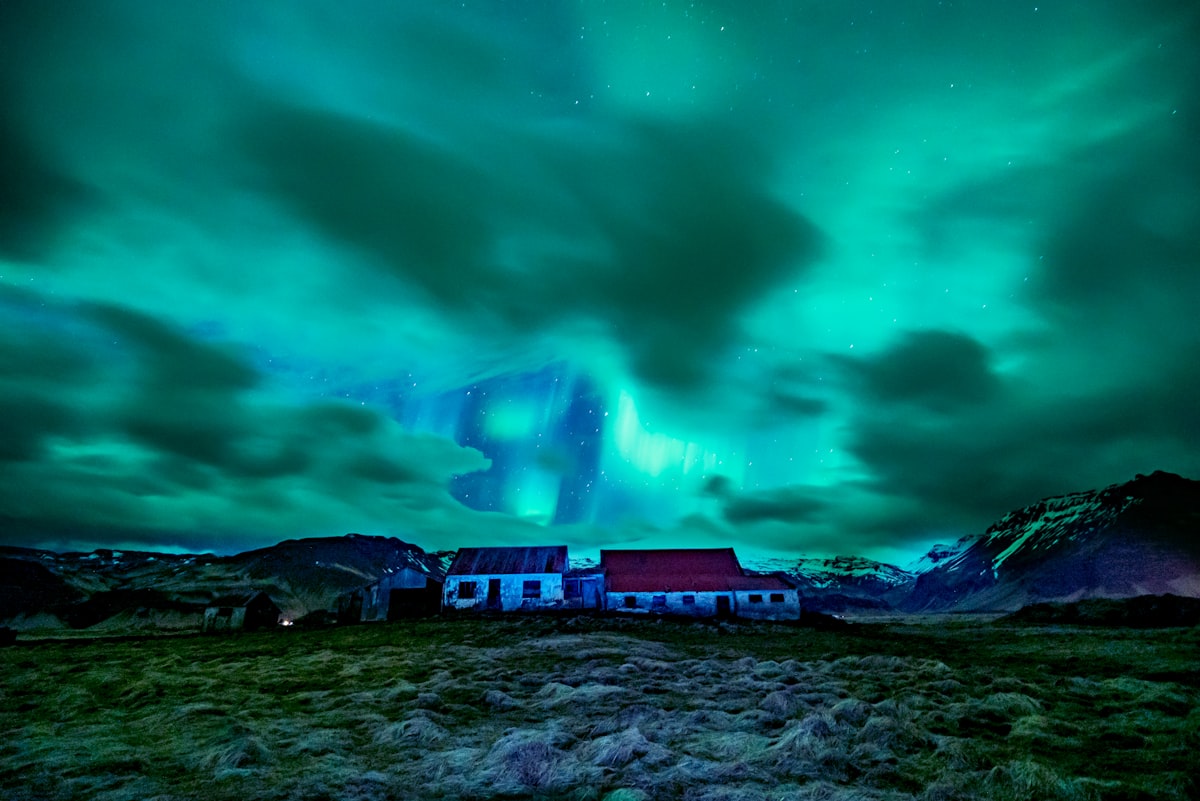
Every aurora forecast in the world, ours included, is a probability. A webcam is not. It is a photograph of the sky as it was about a minute ago, and on the right night that beats any number on a dashboard.
That makes live cameras genuinely useful, and almost nobody explains how to read one. Here is what an Iceland aurora webcam tells you, and what it cannot.
The One Thing a Camera Does That No Forecast Can
Cloud decides most Icelandic nights, and cloud is far harder to predict than solar activity. A forecast gives you a modelled percentage for a grid square. A camera gives you the sky.
Open a live feed and in one second you know whether that patch of Iceland is open or shut. No Kp number to translate, no model to trust — you are simply looking at it. A webcam is the only aurora tool that reports observation rather than prediction. And if green is showing, the aurora is live over Iceland: that part is settled, and you can stop refreshing forecast pages and start deciding where to stand.
”Live” Is Slower Than You Think
Here is the detail that catches people out, and we only know it because we measured it.
We poll Landhotel’s two cameras for our own app, so we timed how often the picture genuinely changes — hashing the returned image every ten seconds for four minutes against both cameras. Each produced four new frames in roughly four minutes: a new picture about every 63 seconds. In between, the bytes were identical. The image was not updating slowly; it was not updating at all.
That is normal for this class of camera, and it has two consequences worth knowing:
- A frame that looks frozen is usually just a frame. Before you conclude that a camera is broken or the sky is dead, give it two minutes. Refreshing every ten seconds cannot make the picture more current — you are re-downloading the same image.
- A quiet frame is not a quiet night. Substorms build and fade within minutes. A camera sampling once a minute can miss the shape of a burst entirely, and can show you a blank sky ninety seconds before the best display of the night.
It is also why our app refreshes its camera thumbnails every 30 seconds and no faster: past a certain point you are spending a roaming traveller’s data to re-fetch a picture that has not changed.
The Camera Sees More Than Your Eyes Will
A camera collects light over a long exposure; your eyes cannot. That is a real advantage — a faint arc often reads clearly on screen while it is still barely perceptible overhead, which makes a webcam an early warning on a night that looks like nothing from the doorstep.
It is also the most common source of disappointment in Iceland. Vivid green on a screen can be a pale grey band in person. The camera is not lying; it is doing something your eyes are not built to do, which is why we wrote a guide on what the northern lights actually look like to the naked eye.
Read a webcam as evidence that the aurora is present, not as a preview of what you will see.
One Camera Is One Point on a Very Large Island
This is the limitation that matters most, and it is nobody’s fault — it is geography.
Look at where Iceland’s best-known aurora cameras actually are. The LAVA Centre and Midgard Base Camp cameras are both at Hvolsvöllur; Landhotel’s two are near Hella, about 20 km away; the SkylineWebcams feed looks over Lake Apavatn. All of them sit in the same corner of the south. The main exception is the Aðaldalshraun all-sky camera near Húsavík — one northern viewpoint against a cluster of southern ones.
So a green sky at Hella tells you the aurora is switched on. It tells you nothing about whether the sky is clear at Akureyri, over 200 kilometres away with an entirely different weather system, or in the Westfjords, or on Snæfellsnes. On a typical Icelandic night the clear sky is somewhere but not everywhere, and a camera 250 km from you is answering a question about someone else’s evening.
That gap is exactly why we score 137 spots across 14 regions separately instead of publishing one national number, and why our comparison of the Iceland aurora apps judges them on whether they alert you for where you are standing.
The Workflow That Actually Works
Combine the two and each covers the other’s weakness:
- Check a camera to confirm the aurora is live. Real-time, observed, no forecast required.
- Check the per-spot score to decide whether it is worth driving from where you are. That is the part a fixed camera in the south cannot answer for you.
- If your own area is clouded in, check what is scoring nearby. Our guide to what to do when it is cloudy covers how far is worth driving.
The Tonight page does step two for the whole country, and the Aurora Iceland app does it for wherever you are standing — with the same live cameras built in, so you are not juggling tabs at midnight.
Where to Watch
We host two live cameras on our Iceland aurora webcams page, both belonging to Landhotel near Hella and shown with their permission. The hotel sits in open farmland well away from any town, so there is almost no ground light in the frame — which is what lets a faint aurora register at all, and why these two are worth a bookmark over a camera pointed at a lit street. It is also an ordinary scored spot in our data, so you can check Landhotel itself on any night.
One thing that confuses visitors: the timestamp burned into the corner is Icelandic time, which is UTC all year, because Iceland never changes its clocks.
Keep a camera open in one tab and your score for tonight in the other. The camera tells you whether. The score tells you where. You need both.