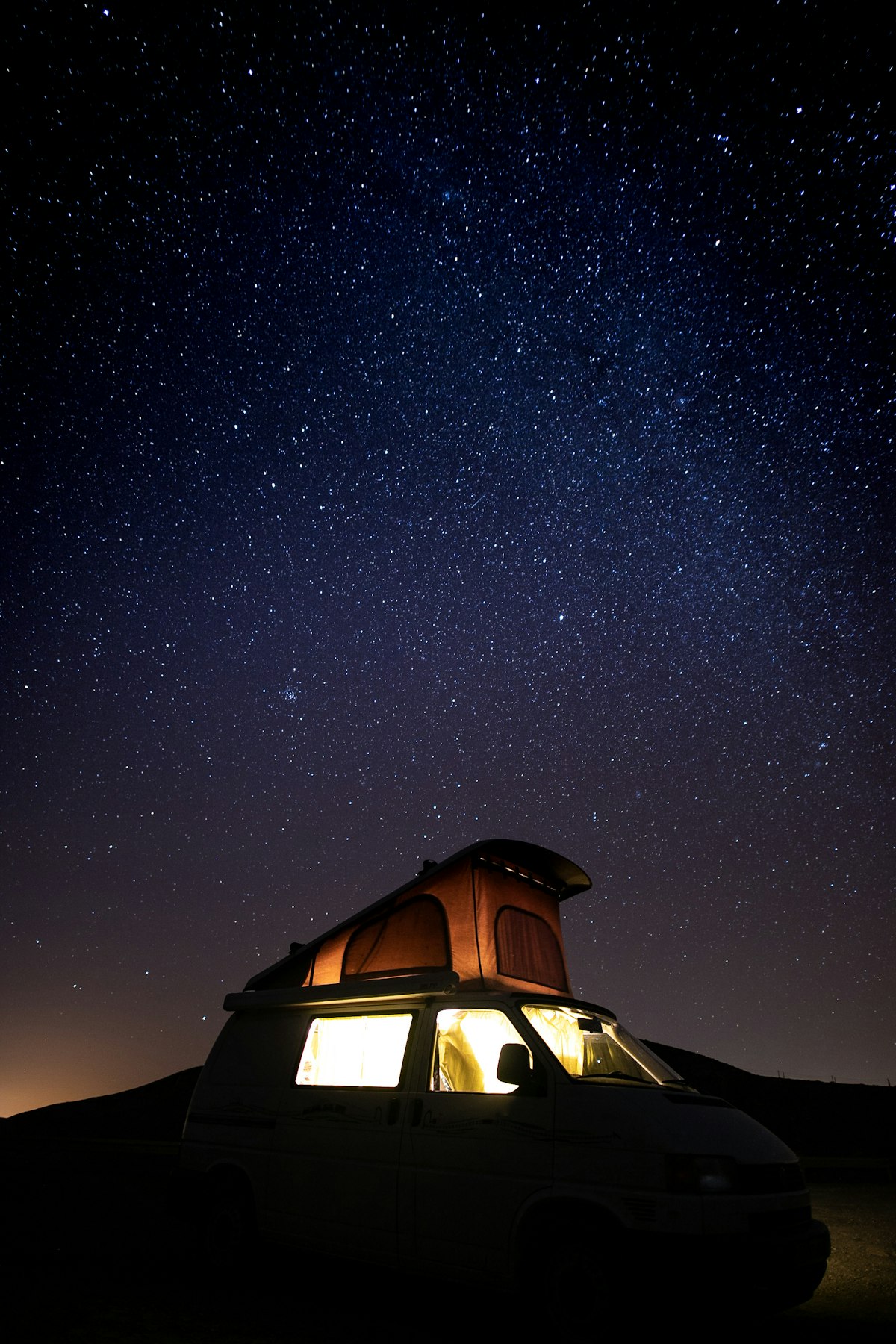
A campervan is, on paper, the perfect aurora vehicle. You are not tied to a hotel booking made three months ago in a country whose weather changes every forty minutes. You sleep wherever the sky is clear, wake when the display fires, and step outside already in position.
That is mostly true. But almost every campervan guide online is published by a company that rents campervans, and there are two facts about winter aurora chasing in a van that none of them lead with. Both shrink the trip considerably.
If you are still choosing a vehicle, you can compare rental cars and campervans across Icelandic suppliers — but read the next two sections first, because they may change what you book.
Some links in this guide are affiliate links: we earn a commission if you book, at no extra cost to you. It never affects what we recommend or how we score a spot.
Fact One: You Cannot Just Park Somewhere Dark and Sleep
This is the one that surprises people, because “wild camping” is such a fixture of van-life marketing. In Iceland it is not legal for a vehicle.
Under Act No. 60/2013 on Nature Conservation, amended in 2015, spending the night in a campervan, motorhome, caravan or similar vehicle outside a registered campsite or urban area is prohibited unless the landowner has given you explicit permission. It applies regardless of how remote, empty, or harmless the pull-off looks. Enforcement is real, fines are real, and in popular regions it is taken seriously because of the environmental damage that followed the tourism boom.
Iceland’s famous “right to roam” covers walking and, in limited circumstances, tents on uncultivated land — it has never covered sleeping in a vehicle. So the aurora fantasy of parking at a dramatic clifftop and dozing until the sky lights up is not the trip you are going to have. What you get instead is a network of 200-plus registered campsites, which is genuinely plenty. In summer.
Fact Two: Most of Those Campsites Are Shut When the Aurora Is Out
Here is the fact that decides winter campervan trips. Iceland has over 200 registered campsites, and roughly 26 stay open year-round. The rest close at the end of September or in October and reopen in May — which is to say, they are closed for essentially the entire aurora season.
So the winter campervan map is not the summer campervan map with colder weather. It is a much smaller, much sparser map, and you have to plan your nights around it rather than around the scenery. The good news is that the surviving sites are reasonably well spread, and several of them sit beside genuinely dark country. Checked in August 2026, the winter-open list includes:
- Southwest: Laugardalur in Reykjavík (convenient, but inside the city light dome), Úlfljótsvatn, and Grindavík near the Blue Lagoon
- South coast: Selfoss, and Hamragarðar beside Seljalandsfoss
- Southeast: Skaftafell — winter zones only, and the sole real option in a long, otherwise empty stretch
- North: Hamrar at Akureyri, Hlíð at Mývatn, Ártún near Grenivík, Laugum, Blönduós
- East: Egilsstaðir, Djúpivogur, Móðrudalur, Fljótsdalsgrund, Vopnafjörður
- West: Stykkishólmur, Búðardalur
Opening dates do change, so confirm on tjalda.is before you commit to a route — the southeast in particular is thin enough that one closure rearranges your whole week.
Park at a Dark Spot, Not a Scenic One
Once you accept that your bed has to be at a campsite, the planning question becomes: which campsite puts me nearest a spot that will actually score well tonight? That is a different question from which campsite has the best view, and it is the one the rental blogs never answer, because answering it requires live per-spot data.
The pairings that work are the ones where a winter-open site sits within a short drive of dark, scored country:
- Hlíð at Mývatn puts you beside Mývatn and Goðafoss, in some of the darkest inhabited country in Iceland
- Ártún near Grenivík trades Akureyri’s town glow for real darkness at Grenivík, twenty-five minutes away
- Djúpivogur and Egilsstaðir put the East in reach, including Vestrahorn
- Skaftafell anchors the southeast within reach of Jökulsárlón
- Selfoss keeps Þingvellir and the Golden Circle inside an hour
The rhythm is: sleep at the legal site, drive the twenty to forty minutes to the dark spot when the numbers look good, then drive back. The Aurora Iceland app scores 137 individual spots every five minutes against real cloud observations, so you can see which side of your campsite is clearing before you turn the key. Our self-drive guide covers the night-driving technique in more detail, and the 7-day road trip itinerary gives you a route to hang these stops on.
The Night Mechanics Nobody Warns You About
Three practical things separate a van night from a guesthouse night:
Sleeping through it. A van at a dark campsite tempts you to sleep and “wake up if something happens.” You will not. Set an alarm for the 22:00-01:00 magnetic-midnight window, or an app alert, and accept that you are getting up.
Condensation and frost. Two people breathing overnight in a small metal box puts a lot of water into the air, and it freezes on the inside of the windows. You can wake to a van you cannot see out of. Crack a vent, and keep a scraper for the inside of the glass.
Power across a fifteen-hour night. Heater, lights, and phone charging all draw from a leisure battery that is not being topped up by a driving day in December. Know your amp-hours, and do not assume a campsite has a free hookup — many winter sites run reduced facilities.
The Honest Verdict
A campervan in September or early October is a genuinely excellent way to chase the aurora: campsites are still open, nights are already dark, and the freedom is real. A campervan in December is a harder trip than a car plus a guesthouse — fewer open sites, brutal weather, long hours in a cold box, and no drying room for wet gear. If it is your first Icelandic winter, that is worth being honest with yourself about. Our dark-sky base guide covers the fixed-accommodation alternative, and the winter packing list applies double in a van.
Whichever way you sleep, the thing that finds the aurora is knowing which direction is clear. Check the Tonight page or the Aurora Iceland app before you settle in for the night, and let the scores — not the map pin — decide where you park.