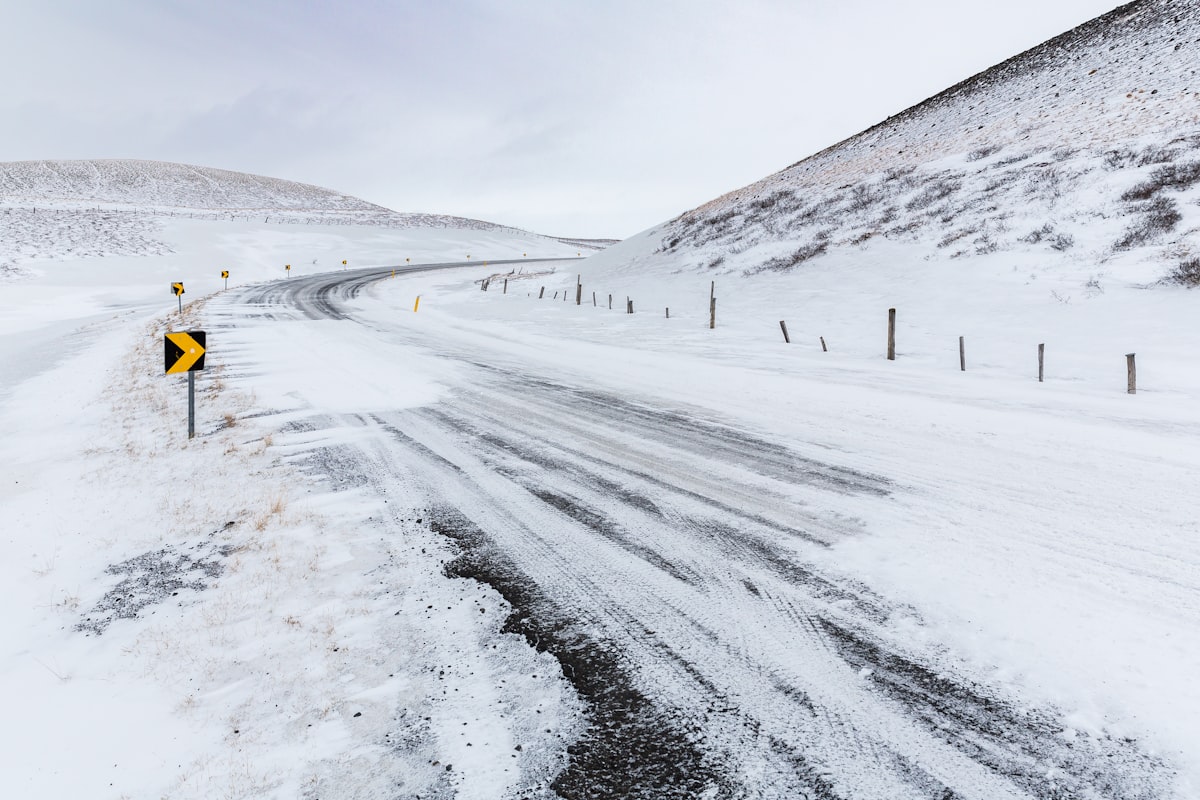
Almost every northern lights guide treats cloud as the enemy. In an Icelandic winter, the thing that actually ends your night is more often a road: closed, drifted over, or glazed with the kind of ice that turns a 40-minute drive into a two-hour crawl. You can be looking at a perfect score at a spot you cannot safely reach.
This guide covers the half of aurora chasing that happens on the ground. If you want route and timing strategy, our self-drive planning guide owns that, and where to sleep is the campervan guide’s job. This one is about whether the road is open, and what to do when it is not.
One honest caveat up front: we surface road status inside the app, but we are not a road-safety authority. Vegagerðin (road.is) and safetravel.is are, and they overrule anything you read here.
Some links below are affiliate links: we earn a commission if you book, at no extra cost to you. It never affects what we recommend or how we score a spot.
The Accident Nobody Warns You About
The aurora causes its own class of road accident, and it is not ice. It is drivers looking up instead of ahead. A bright substorm fills the windscreen, everyone in the car reacts, and the person steering reacts too.
The correct response is more specific than “pull over”. Pull completely off the road — into a marked lay-by, a car park, a farm track entrance — not onto the shoulder. Icelandic rural shoulders are soft, narrow and often drop away, and Route 1 in the dark carries other people doing exactly what you are doing.
Then kill your headlights, including daytime running lights. This is one instruction that serves three purposes at once: it protects your own dark adaptation, which takes about 20 minutes to build and one second to destroy; it stops you blinding the driver coming the other way; and it makes the aurora dramatically easier to see.
What Road.is Actually Tells You
Vegagerðin publishes a live feed covering around 700 road segments nationwide. We poll it every 15 minutes and match each segment to the nearest access road for 75 of our viewing spots, so a spot can tell you the state of the road you would actually drive to reach it.
The condition codes matter more than the map colours, because the codes are precise:
- Greiðfært (easily passable) — normal winter driving. On a live check this morning, 591 of 701 segments were in this state.
- Hálkublettir (icy patches) — the most common winter reading, and the one people underestimate. Isolated ice on an otherwise clear road is more dangerous than uniform ice, because you drive it at clear-road speed.
- Hált / Flughált (icy / extremely icy) — flughált literally means “flying-slippery”. Treat it as a reason to pick a closer spot.
- Snjóþekja / Krap (snow cover / slush) — passable, slow, and a real problem on gradients.
- Þungfært (difficult passage) — heavy going, usually deep snow. Not a road for a 2WD hire car at 23:00.
- Ófært / Lokað (impassable / closed) — the answer is no. There is no version of the aurora that justifies this.
- Ekki í þjónustu (not in service) — the road is not being maintained at all. Nobody is coming to grit or plough it.
- Fært fjallabílum (mountain vehicles only) — 83 segments carried this today. It means a modified 4x4, not the 4x4 badge on a rental Duster.
The 22:00 Problem
Here is the thing that no rental-company winter-driving page will tell you, because it undercuts the tidy advice to “just check road.is before you go”.
Vegagerðin staff update conditions between roughly 07:00 and 22:00, October to April. Aurora hunting happens from about 21:00 to 02:00. So for most of the hours you actually care about, the “live” road status you are reading is the last reading a human entered before they went home.
That has three practical consequences:
- The 23:00 reading is the 22:00 reading. A road that iced up at midnight looks fine on the feed.
- Weather moves faster than the feed. If it started snowing after 22:00, believe the windscreen, not the website.
- Check before you leave, not just when you arrive. The most useful check is the one at 20:00, while the data is still being actively maintained and while you can still change your plan.
This is exactly why the honest workflow is cloud map first, road second — and why the turn-around rule below is not optional.
Check the Cloud Map First, Then the Road
The ordering is counter-intuitive and it saves time. Cloud decides whether the night is worth driving at all; roads decide which of the remaining options you can reach. Run it the other way and you spend twenty minutes researching access to a spot that is under total overcast.
So: find the clear sky first, using the Tonight page or the live per-spot scores. Our guide to chasing a clear sky when the forecast says cloudy covers that half in depth. Then, and only then, check whether the road to your best-scoring candidate is open — and if it is not, drop to the next one on the list. A “Good” score you can reach beats an “Excellent” score behind a closed pass every time.
Four Spots That Close Just as the Season Opens
Some places are not a road-condition question at all — they are simply gone for the winter. Four of our spots carry a hard seasonal window, and all four shut at the end of September, almost exactly as aurora season gets going:
- Landmannalaugar and Glymur — open June to September
- Þakgil — open May to September
- Bláfjallafoss — open July to September
These are highland F-roads and a trail with a river crossing, not roads that merely get difficult. We hide them from the rankings outside their window rather than letting a summer-only F-road top the list on a January night and send someone toward an unmaintained mountain road in the dark.
Wind, and the Turn-Around Rule
Wind is Iceland’s underrated hazard. It does not just make standing outside unpleasant — it rips car doors off their hinges, which is the single most common winter rental-damage claim in the country. Open your door with a hand on it, into the wind, every time.
The thresholds our own route planner warns at, in km/h:
- 55+ — strong wind, drive carefully
- 80+ — dangerous, seriously consider not driving
- 100+ gusts — stay indoors; this is not an aurora night
And the rule that matters most, which is easy to write and hard to follow at 23:30 when the sky is finally doing something: decide your turn-around condition before you leave, and honour it. Ours is simple — if you are driving slower than 50 km/h on a road you expected to take at 90, or if you cannot see the next reflector post, the night is over. Go back. The aurora runs from late August to mid-April and there will be another one; there is exactly one of you.
If you have not booked a car yet, compare rental cars and campervans across Icelandic suppliers — in winter, prioritise a genuine 4x4 and studded tyres over the headline price. And dress for standing still in wind, not for driving: our winter packing list covers the gear that actually matters when you are motionless for an hour.
The Bottom Line
Cloud gets the attention, but the road decides whether your night happens. Read the condition codes rather than the colours, remember that the feed effectively stops being updated at 22:00 just as you set out, check the sky before you check the tarmac, and set a turn-around rule you will actually obey. Choosing a base within reach of several spots — the logic in our dark-sky base guide — removes most of this problem before the trip starts.
Open the Tonight page or the Aurora Iceland app before you set out: it scores 137 spots across Iceland every five minutes and flags the road to each one, so you can pick a spot that is both clear and reachable — which is the only combination that ends with you actually seeing anything.