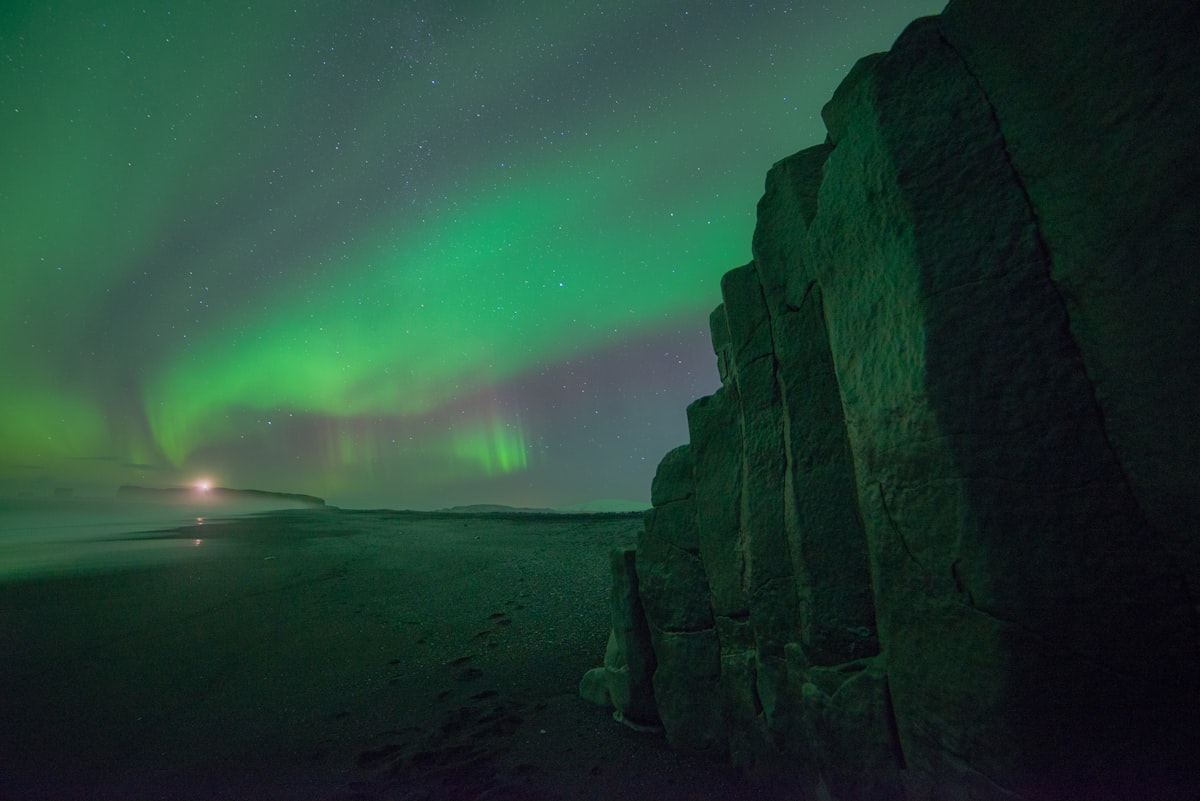
Few places in Iceland put the northern lights over a foreground as dramatic as Reynisfjara, the black-sand beach just west of the village of Vík í Mýrdal. You get jet-black volcanic sand, the towering Reynisdrangar basalt sea stacks rising straight out of the surf, and a wide, dark southern sky open to the whole North Atlantic. It is one of the most photogenic aurora spots on the South Coast — and, honestly, one of the most dangerous places to stand in all of Iceland. This guide covers both: where to go, when to go, how to shoot it, and the safety rule that has to come first.
Why Vík and Reynisfjara are a bucket-list aurora spot
Vík is the southernmost village on the ring road, about 180 km (a 2.5-hour drive) from Reykjavík on Route 1, and it is a major overnight hub for anyone touring the South Coast. That matters for aurora hunting, because the lights are a game of patience — you want to be staying nearby and stepping outside after dark, not driving home at midnight.
Three things make the area special:
Sea-stack foregrounds you can’t shoot anywhere else. The Reynisdrangar stacks are 66-metre basalt pillars standing offshore, and local folklore says they are two trolls caught by sunrise while dragging a ship to land. Put them under a band of green and you have a photograph nobody takes at a roadside pull-off.
Genuinely dark skies. Vík is a small village with very little light pollution, and Reynisfjara faces the open ocean to the south — no town glow on the horizon in the direction you’re looking. Our live spot forecast for Vík gives you the real-time aurora and cloud score for exactly this stretch of coast.
A dramatic second viewpoint next door. The Dyrhólaey promontory, a few minutes west, sits high above the coast with its famous rock arch and a long view back toward the Reynisdrangar stacks — a completely different composition from the same night.
The sneaker-wave warning you have to take seriously
Most aurora guides to Reynisfjara mention the danger in passing. We won’t, because this beach has killed visitors. Reynisfjara is notorious for sneaker waves — surges that run far higher up the sand than the waves before them, with no warning, in water cold enough to cause shock within minutes. People are swept off their feet and dragged out every year.
The rules are simple and non-negotiable, and they matter even more in the dark when you’re watching the sky instead of the sea:
- Never turn your back on the ocean. Not for a photo, not for anything.
- Stay well up the beach, above the highest wet-sand line. If the sand is damp where you’re standing, a wave has already reached that far — move back.
- Watch the warning lights. Icelandic authorities installed a signal system at the entrance; treat yellow, orange, or red as a reason to keep well back or leave.
- Keep children and anyone unsteady far from the water.
None of this stops you seeing the aurora. The best compositions here use the sea stacks and the basalt columns as foreground, and those are shot from high on the beach anyway. Respect the sea and Reynisfjara is spectacular; ignore it and it is genuinely deadly.
Where to stand once you arrive
There are three good vantage points within a few minutes of each other:
- Reynisfjara beach itself — walk in from the car park and set up high on the sand, well back from the surf, with the Reynisdrangar stacks and the Gardar basalt columns (by Hálsanefshellir cave at the eastern end) as foreground.
- The church hill above Vík — Víkurkirkja, the little white church on the rise above the village, is an easy, safe, elevated viewpoint looking out over the town and the stacks. Free parking and no waves. A good fallback if the wind on the beach is punishing.
- Dyrhólaey — the promontory west of the beach, with the arch and cliff-top views. The access road is steep switchbacks and the cliff edges are unfenced, so it’s a fair-weather, careful-driving option, not a stormy-night one.
All of these are completely exposed to coastal wind, and standing still for an hour here in winter is brutally cold — colder in feel than the thermometer says. Our winter packing list for aurora hunters is written for exactly this kind of stationary, wind-blasted vigil.
Photographing the aurora over the sea stacks
This is a tripod location — there’s no hand-holding a night shot worth keeping.
- Camera: wide lens (14–24 mm), aperture wide open (f/2.8 or faster), ISO 1600–3200, shutter 5–15 seconds depending on how fast the aurora is moving. The full workflow is in our aurora camera settings guide.
- Phone: modern iPhones and Pixels do a real job here in night mode on a small tripod — see how to shoot the aurora on an iPhone.
- Compose for the stacks. A faint aurora above the Reynisdrangar silhouette beats a brighter one over an empty horizon. Put the stacks or the basalt columns in the lower third.
- Bring spare batteries warm in an inside pocket — cold drains lithium cells fast, and Vík is a long way from a replacement.
If you’re building a South Coast photography run, pair this with the ice-block foregrounds at Jökulsárlón and Diamond Beach a couple of hours further east — the two make the best aurora-photography stretch in the country.
When to go and how to check first
The aurora season at Vík runs late August through mid-April — summer is out, because the midnight sun keeps the sky too bright. On any given night the strongest two-hour window is statistically 22:00–01:00; the reasoning is in our best time of night guide.
The one thing to know about this coast: the South Coast is among the cloudiest, wettest parts of Iceland, so the deciding factor most nights isn’t the aurora strength — it’s whether the sky above Vík is actually clear. Before you commit, open the Tonight page and check the live score for Vík alongside the other South Coast spots. If Reynisfjara is socked in but a gap is open further east or inland, you’ll see it in one view. The Aurora Iceland app updates every five minutes and points you to the nearest clear spot, so a cloudy forecast over the black sand doesn’t have to end your night.