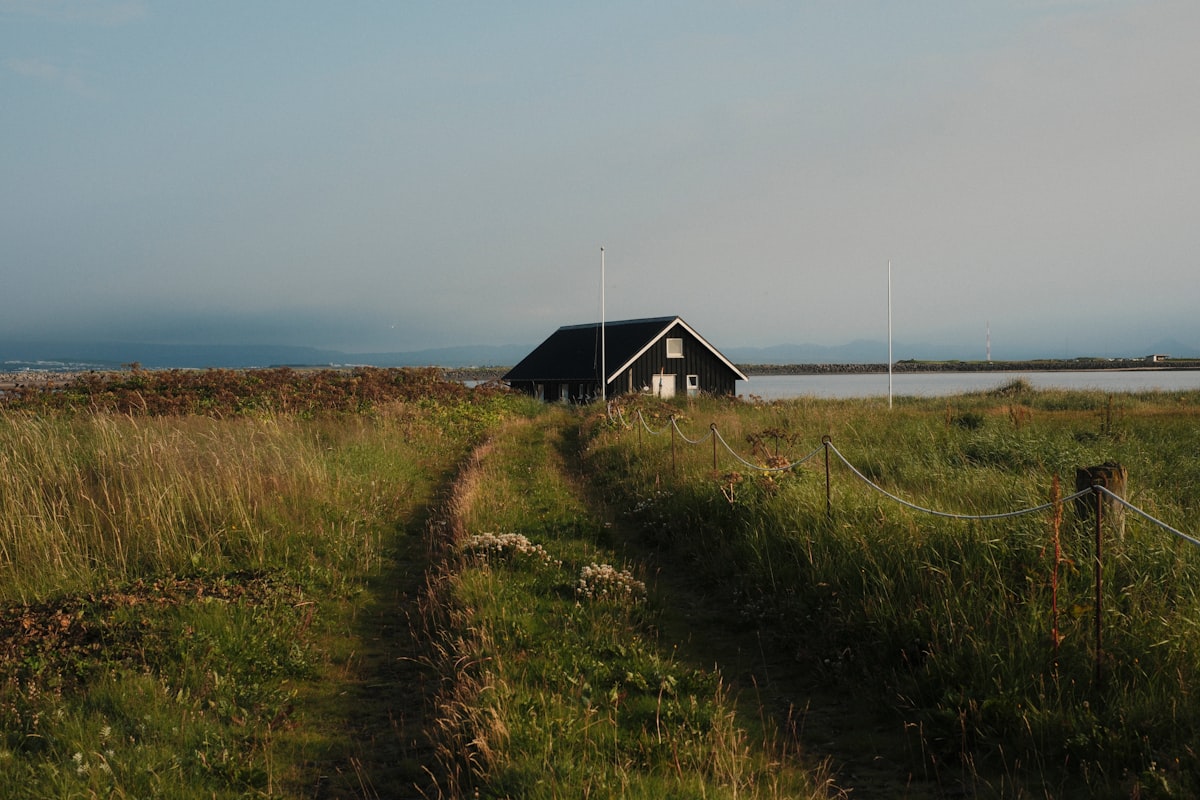
Search for northern lights accommodation in Iceland and you will get the same thing over and over: ranked lists of glass-roof hotels and lodges with an aurora wake-up call. Those lists sell rooms. They do not answer the question you are actually asking, which is where should I sleep so that I have the best chance of seeing something.
The Real Question Is How Far You Sleep From Streetlights
Aurora visibility is decided by three things on any given night: darkness, cloud, and geomagnetic activity. You cannot influence the last one. You can influence the first two enormously, and both of them are decided by where you booked.
Reykjavík has real light pollution. A moderate display that would be obvious from a dark field looks like a faint grey smudge from a city street, if you notice it at all. The fix is not expensive: 30 to 60 minutes of driving from the capital gets you into genuinely dark country. Everything else in this guide follows from that one fact.
The second fact is that Iceland’s weather is intensely regional. It is completely normal for the south coast to be socked in under low cloud while the interior plains or the north are clear. A base that lets you move 40 minutes toward a hole in the cloud is worth more than a base with a nicer view.
So the criteria are: dark where you sleep, and mobile enough to chase.
The Four Bases That Actually Work
The Þingvellir–Hella corridor (30–75 minutes from Reykjavík). The best all-round choice for a first trip. You are far enough from the capital glow to be properly dark, close enough to fly in and out of Keflavík without burning days on the road, and positioned between two different weather zones so you can drive toward whichever is clearer. Þingvellir and Hella both score well on clear nights and are easy to reach on paved main roads.
The South Coast (Vík and around). Dramatic foregrounds, black sand, and waterfalls. The honest trade-off is that this is one of the wettest, cloudiest parts of the country. Beautiful when it works, frustrating when a front parks over it for three days.
Snæfellsnes. Excellent dark skies, Kirkjufell as a foreground, and a manageable drive from Reykjavík. A strong second-trip choice.
The North (Mývatn and around). Statistically drier and clearer than the south, with long dark nights and almost no light pollution. Lake Mývatn is about as good as a base gets in Iceland. The cost is access: you either fly domestically to Akureyri or commit serious driving time.
We go deeper on the regional trade-offs in our North Iceland vs South Iceland comparison.
Akureyri vs Reykjavík: The Decision Most People Get Backwards
This one comes up constantly, and the intuitive answer is wrong in both directions.
People assume Akureyri wins because it is further north. The latitude gain is real but small — Iceland sits under the auroral oval almost end to end, so a couple of degrees changes very little. What actually favours the north is weather: less cloud and less rain than the south coast over a typical autumn or winter week.
But Akureyri is a town, and towns have streetlights. Basing yourself in central Akureyri and expecting dark skies is the same mistake as basing yourself in central Reykjavík. The north’s advantage is real only if you sleep — or at least drive — outside the town, which is why Mývatn keeps coming up.
Meanwhile Reykjavík wins decisively on flights, car hire, tour availability, and the sheer number of good spots within an hour. For a short trip, that convenience usually beats the north’s weather edge. Our Akureyri guide covers the northern option in detail.
Book Multiple Nights in One Place, Not a Different Town Every Night
The single most common planning mistake is a rolling itinerary — one night in Vík, one in Höfn, one in Akureyri. It is the worst possible structure for aurora hunting.
Aurora chasing rewards weather flexibility, and a packed driving schedule removes it. If you are committed to being 300 km east tomorrow, you cannot spend tonight driving 40 minutes west toward the only clear sky in the region. You are locked to whatever is above your booked bed.
Three or four nights in one dark-sky base, with a car and no fixed obligation to be anywhere the next morning, will beat six nights of hopping. If you are still deciding on trip length, we worked the numbers in how many nights you actually need.
A Short Booking Checklist
Before you confirm anything, check:
- Is it outside a town? Look at the property on a satellite map. If you can see streetlights along the road, it is not a dark base.
- Do you have a car? A rural base without one is a trap. You are stuck with one patch of sky.
- Can you step outside at 01:00? Somewhere you can walk out the door and look up beats somewhere requiring a drive at midnight.
- Are you staying at least two nights? One night in one place is a coin flip.
- What is the drive radius? From your base, how far to the next distinct weather zone? Under an hour is good.
A rural guesthouse or farm stay usually beats a city hotel plus a long guided coach for exactly these reasons — you keep control of your own timing, and you are already standing in the dark when something starts.
Once you have picked a base, the nightly decision becomes simple: check the live score for the spots near you, see where the cloud is thinnest, and drive to the best one. That is what our live aurora forecast is built for — 100+ individually scored locations across Iceland, updated every few minutes with real cloud observations. Download the Aurora Iceland app and let it tell you which way to point the car.