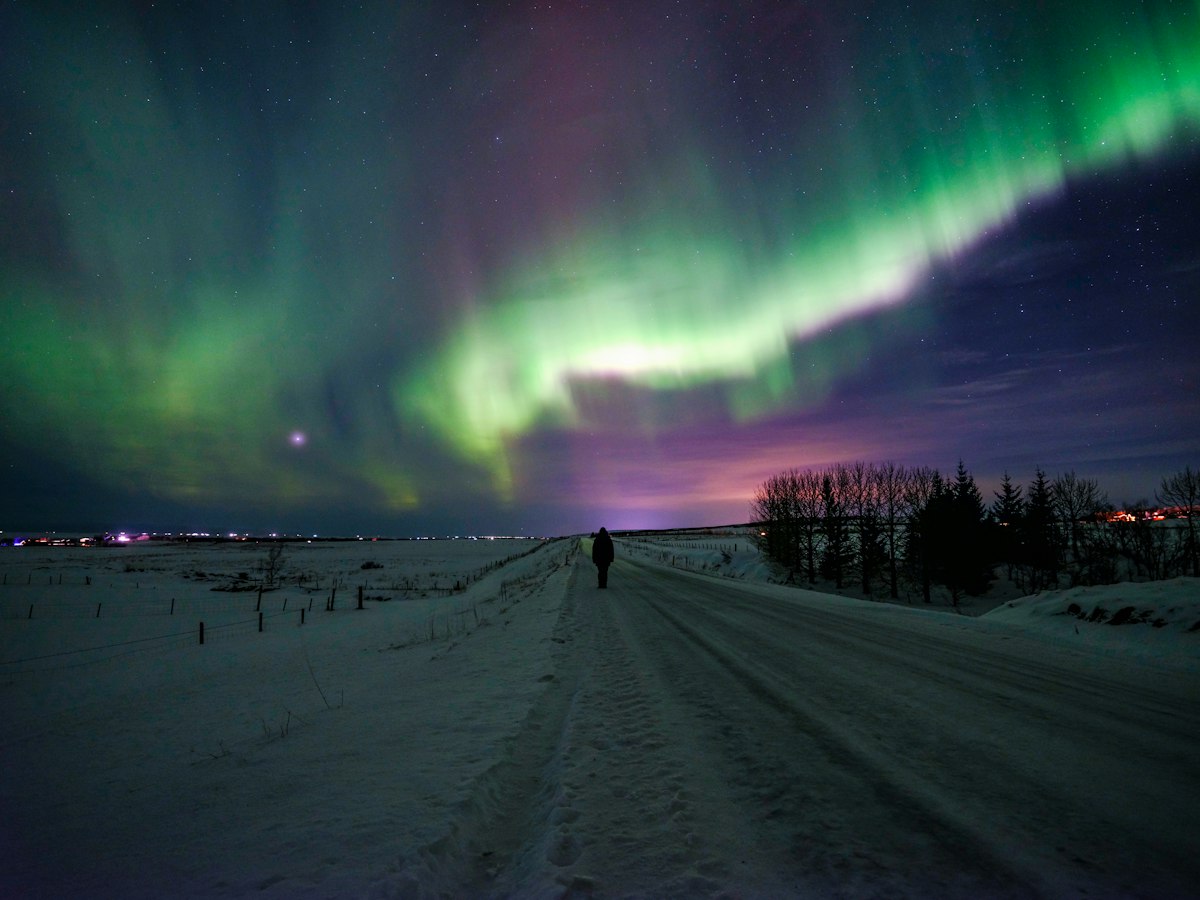
The Short Answer
A bright burst of northern lights usually lasts minutes, and the full cycle around it lasts an hour or more. On an active night that cycle can repeat, and on a quiet one a faint arc can sit in the sky for hours and do very little. So the question has three answers, depending on whether you mean the dancing, the display or the night.
Those lengths come from the auroral substorm, the process behind the sudden brightening people travel to see. The citizen-science project Aurorasaurus gives these typical durations for each phase:
| Phase | What you see | Typical length |
|---|---|---|
| Growth | A quiet arc, often faint | Hours |
| Onset or breakup | The arc suddenly brightens | 10-15 minutes |
| Expansion | Bands spread and move quickly | 15-30 minutes |
| Recovery | Patches and pulsing light that slowly fade | 1+ hours |
These are typical figures, not a timetable. Some nights skip the drama entirely, and a phase can run much shorter or longer than the table says.
Three Nights in Our Feed, Timed
The clearest way to show this is with real nights. The timings below come from photos people posted to the community feed in our app. Iceland is on UTC all year, so these are also local times.
Halloween, 31 October. NOAA’s Kp index read 3.33 for 15:00-18:00, 6.00 for 18:00-21:00, a G2 storm, and 3.67 for 21:00-24:00. In our feed, 11 people posted 17 photos between 18:46 and 19:57, a span of 71 minutes. The first has a blue twilight sky behind the rays, because astronomical darkness in Reykjavík did not begin until 19:59. A moon about 61% lit rose at 20:36, and the feed stayed empty until 23:56. Three more photos then arrived by 00:08, as Kp read 4.67 for 00:00-03:00.
The night before, 30 October. Kp jumped from 1.33 to 4.33 in the last three hours of the day. Of the 25 photos taken that evening, between 21:06 and 23:27, 20 fall in the 22:00 hour. Five more came between 02:14 and 05:38, when Kp was only about 3.
21 October. The same shape again: 22 of the evening’s 27 photos fall in the 21:00 hour.
One caveat matters here. These timestamps show when people were outside with a phone, not when the aurora started and stopped, and an empty stretch in the feed does not prove an empty sky. Even so, the bunching is hard to miss: the moment most people thought worth photographing lasted about an hour.
Halloween also shows the limit of a Kp number. Kp is a three-hour reading, so “Kp 6” cannot tell you which of those hours mattered. Two days earlier, NOAA’s forecast had the peak in the early hours of the 31st and an easing that evening. It got the storm’s rough timing and missed the hour, which is common. Our piece on how accurate the aurora forecast is explains why.
What Makes a Display Last Longer
A few things decide whether you get twenty minutes or a whole night:
- The solar wind. A southward Bz keeps feeding energy into the system, and displays often fade after it turns north. Our guide to reading an aurora forecast explains the number.
- The kind of storm. A coronal-hole stream can keep conditions raised for a long time. After Halloween’s peak, NOAA still read Kp 4.33 for 03:00-06:00 on 1 November.
- Darkness and moonlight. The sky limits what you can see of a display. A storm that starts in twilight, or runs into a bright moon, looks shorter than it really is.
- Cloud. Activity can carry on for hours above a sky that closed over after ten minutes.
- Your eyes. Faint aurora reads as a pale grey, so a display can seem to end while a phone still shows green. Here is what the northern lights look like to the naked eye.
How Long to Stay Out
These are rules of thumb, not statistics:
- Plan on two to three hours outside on a clear night. If you can only pick one stretch, make it 22:00 to 01:00, though Halloween shows a display can come well before that.
- Do not leave during a lull. A display can fade for twenty or thirty minutes and then come back brighter.
- Stay for the recovery. After a burst, give the sky at least another hour. The pulsing patches are easy to miss if you have already turned for the car.
- Give up on evidence, not boredom. Two quiet hours, a falling score on the live aurora forecast and cloud closing in are good reasons to go to bed. With clear skies and a score that is holding, stay.
Waiting is much easier close to home. A short hop such as Grótta lets you go back indoors to warm up, and if you only have one night in Reykjavík, it is worth staying out longer than feels reasonable. Because a good burst can be this short, how many nights you stay matters more than any single forecast.
Let the App Do the Waiting
You do not have to stand in the cold watching a quiet sky. The Aurora Iceland app scores 137 viewing spots every five minutes and can send you an alert when conditions pick up, so you can wait somewhere warm and still be outside for the part that lasts minutes.