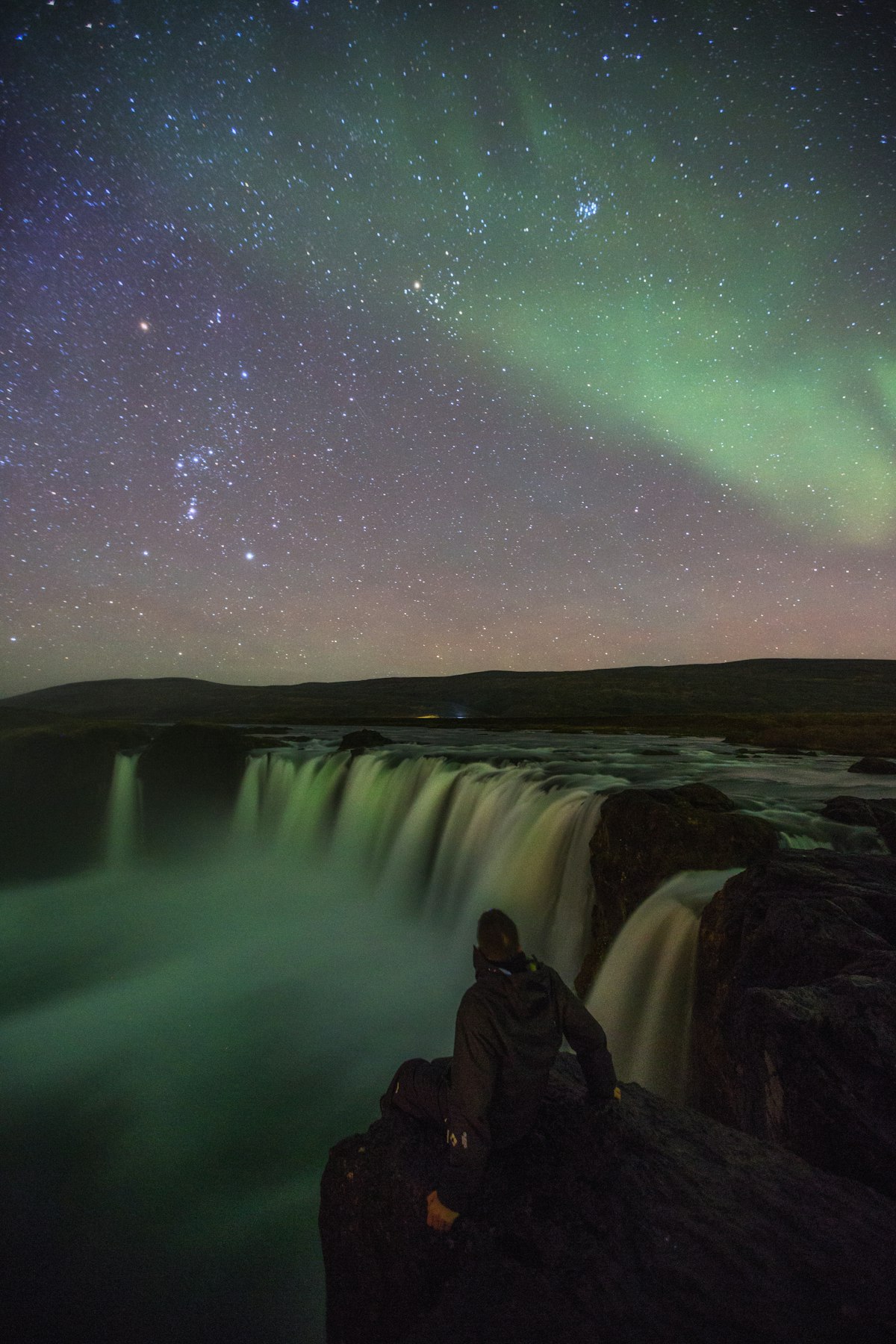
The Golden Circle is Iceland’s most famous day trip — Þingvellir, Geysir, and Gullfoss, all within about 90 minutes of Reykjavík. What almost nobody tells you is how differently those three stops perform once the sun goes down and you are hoping for the northern lights. They are not interchangeable after dark. One of them is genuinely excellent for aurora; the other two can actively work against you. Here is the honest ranking, and how to drive the loop as an aurora chase rather than a checklist.
The Golden Circle Is a Daytime Loop — Here Is the Night Version
Search for “northern lights golden circle” and you will get a wall of combo tours: sightseeing by day, aurora hunt bolted on at night. That is fine, but it hides a simple truth for self-drivers — the three headline stops were chosen for their daytime spectacle, not their night skies. Geysir’s erupting hot spring and Gullfoss’s thundering canyon are daytime wonders. For aurora, the qualities that matter are different: darkness, an open northern horizon, and air that stays clear of local fog and spray.
If you are planning to self-drive the loop at night, read this alongside our self-drive aurora road-trip guide — this piece ranks the three stops; that one covers how to structure the whole night.
Þingvellir: The Clear Winner After Dark
If you only stop at one Golden Circle site for the aurora, make it Þingvellir. It has the three things the others lack:
- Real darkness. The park sits in a Bortle 3–4 zone. Reykjavík’s light dome is low and to the south-west, away from the northern horizon where the aurora appears.
- An open horizon. The rift valley opens north across Lake Þingvallavatn with no mountain wall to hide a faint arc — the difference between “I definitely saw it” and “was that a cloud?”
- A dramatic foreground. The Almannagjá rift and the lake give photos a sense of place that a roadside pull-off never will.
Park at the Hakið visitor centre and walk to the viewpoint on the edge of the rift. Full directions, the best spots to stand, and no-car options are in our dedicated Þingvellir northern lights guide. Check the live score for Þingvellir before you commit — it updates every five minutes with real cloud data.
Geysir and Gullfoss: Beautiful by Day, Tricky by Night
Here is where the honest advice diverges from the tour brochures.
Geysir sits in an active geothermal field. That is exactly the problem after dark: the ground vents a near-constant plume of warm water vapour and steam that drifts across the sky and scatters any stray light. On a still, cold night the whole basin can sit under a low haze that softens and greys out a faint aurora. The car park and viewing area are also lit for safety, which kills your night vision. It is a spectacular daytime stop and a mediocre aurora spot. Check the Geysir score if you are passing, but do not build your night around it.
Gullfoss has a subtler version of the same issue. The waterfall throws up a steady spray and canyon mist that hangs in the gorge, and in cold weather that mist freezes into a low fog that dulls contrast. The canyon walls also cut off part of the low northern horizon — the exact slice of sky where an early-evening arc first appears. A powerful overhead display will still look wonderful above the falls, but a weak one often gets lost. The Gullfoss score will tell you the cloud situation; treat a good number there as a bonus, not a plan.
None of this means skip Geysir and Gullfoss — see them by day. It means: when the aurora is faint, do not expect these two to deliver, and have Þingvellir or open farmland as your fallback.
Driving the Loop at Night: Route and Clear-Sky Tips
The Golden Circle is a paved loop of roughly 230 km from Reykjavík: Route 36 to Þingvellir, Route 365/37 across to Geysir, a short hop to Gullfoss, then Route 35 back through Selfoss. A few things matter after dark:
- Do it in reverse for aurora. Sightsee Gullfoss and Geysir in the late-afternoon light, then end the night at Þingvellir when it is fully dark and you want the best sky.
- Watch the weather zones. The uplands around Geysir and Gullfoss often sit under different cloud than Þingvellir’s lakeside. If one is socked in, the other 40 minutes away may be clear — that is your reason to move.
- Winter roads. Studded tyres are standard on rentals November–April, but Route 35 and the higher sections ice up fast. Check road.is before and during the drive.
- Kill your lights while watching, park fully off the road, and dress for standing still in wind. Our winter packing list covers the stillness-specific gear.
If the whole loop clouds over, do not just wait it out under overcast — our guide to chasing a clear sky in real time explains why a short drive across a front so often pays off in Iceland.
Use Live Scores to Pick Your Stop
The single most useful move on a Golden Circle aurora night is to stop guessing which stop is clear. The Aurora Iceland app scores Þingvellir, Geysir, and Gullfoss individually every five minutes, combining OVATION aurora probability, live solar wind, and real cloud observations from met.is stations. So instead of driving to Gullfoss on faith and finding it fogged in, you can see at a glance that Þingvellir is scoring “Good” while Gullfoss reads “Low” — and point the car accordingly.
Open the Tonight page before you leave Reykjavík to see which of the three (and everywhere else within reach) is scoring best right now.
The Bottom Line
The Golden Circle is a brilliant daytime route, but for the northern lights its three stops are not equal: Þingvellir wins on darkness, horizon, and foreground, while Geysir’s steam and Gullfoss’s spray fog can quietly smother a faint display. Sightsee the geothermal stops by day, chase the aurora from Þingvellir or open ground by night, and let live cloud data — not the itinerary — decide where you stand.
Before you drive the loop tonight, open the Tonight page or download the Aurora Iceland app and let the clear sky pick your stop.