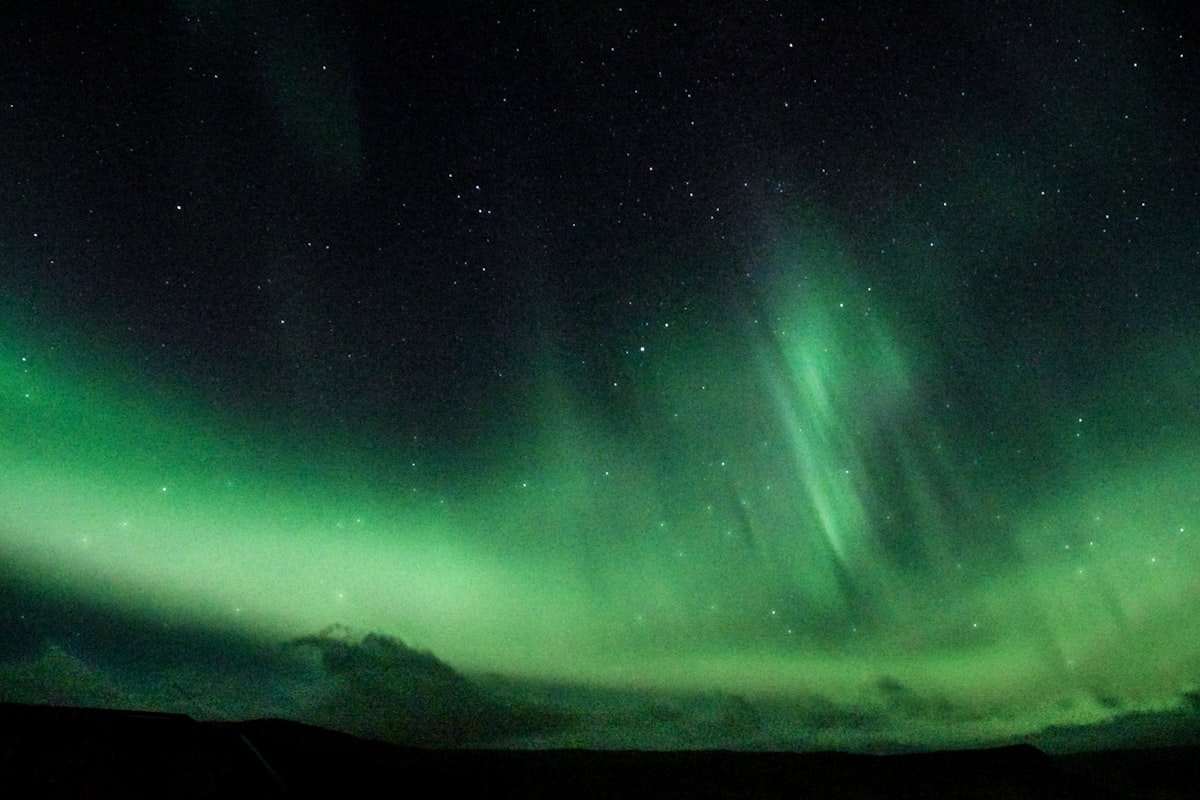
August is the month the answer changes. Ask “can you see the northern lights in Iceland?” on August 1 and the honest reply is still no — the same midnight-sun “no” that holds all summer. Ask it again on August 28 and the answer becomes a cautious yes. August is the hinge of the aurora calendar in Iceland: the season is physically closed at the start of the month and cracked open by the end of it.
If you’re planning a late-summer trip, here’s exactly when the sky goes dark enough, what you can realistically expect to see, and how to be standing in the right place when the first display of the 2026–2027 season appears.
The Short Answer: Early August No, Late August Maybe
For roughly the first three weeks of August, Iceland is still under enough residual daylight that the aurora — even when it’s active overhead — is washed out. The sun sets, but it doesn’t drop far enough below the horizon for the sky to reach the astronomical darkness the lights need. This is the tail end of the same midnight-sun effect we cover in our guide to seeing the northern lights in Iceland in summer.
Then, in the final week to ten days of August, true astronomical darkness returns for a short window around midnight, and the first faint green arcs of the new season become visible from the darkest spots on the most active nights. By August 31 you have a real, if narrow, viewing window. September is when it becomes reliable — but late August is when it reopens.
When the Sky Actually Goes Dark in August
This is the detail most travel sites skip, and it’s the one that decides your trip. Iceland’s nights lengthen fast in August:
- August 1–12: Sunset moves from about 22:30 to 21:57 (the sun sets at roughly 21:57 on August 12). The sky never reaches astronomical darkness — there is no real viewing window yet.
- August 13–20: Sunsets slide earlier toward 21:15, and genuine twilight returns, but the dark window is still too shallow and too short for anything but the strongest events.
- August 21–27: Astronomical darkness reappears for an hour or two around midnight. The first faint displays of the season become possible at dark, rural, coastal spots when solar activity is high.
- August 28–31: The window widens to a couple of usable hours. Sunset is near 20:55, and on an active, clear night you can genuinely see the lights — the season is open.
The takeaway: if you want any chance in August, plan for the last week, and plan to be out between roughly 23:30 and 01:30 when the sky is at its darkest.
What You Can Realistically Expect
Be honest with yourself about late August. You are not getting the overhead curtains of a deep-winter Kp 6 night. The realistic August display is a faint-to-moderate green arc low on the northern horizon, visible to the naked eye on a genuinely dark, clear night, and far more impressive through a phone or camera than to the eye.
Three things all have to line up at once:
- Real darkness — only the final ~10 days of the month qualify.
- A clear sky — late August can be cloudy, and clouds beat any forecast. This is where live, spot-level cloud routing matters most.
- Actual solar activity — and here 2026 helps. Solar Cycle 25 peaked in late 2024, but the declining phase running through 2026–2027 is historically among the most productive for aurora, with frequent coronal-hole streams and CMEs. We explain why “declining” doesn’t mean “over” in is 2026 still a good year for the northern lights?
Where to Be: Get Away From Town
In August the darkness is marginal, so light pollution is fatal in a way it isn’t in December. Reykjavík’s city glow will erase a faint arc that you’d see clearly from 40 minutes away. Drive to genuinely dark ground:
- Þingvellir National Park — 45 minutes east of Reykjavík, dark, with a wide northern horizon over the lake. The most reliable dark-sky spot near the capital.
- Vestrahorn — southeast Iceland, dramatic peaks, almost no light pollution, and the Stokksnes access road is still open before winter.
- North Iceland — higher-latitude spots like those around Akureyri sit closer to the auroral oval, a small edge on a marginal night. See our North Iceland aurora guide.
If you’re chasing a gap in the clouds rather than a single view, our live aurora forecast scores all 104 monitored spots every five minutes on real-time cloud cover and activity.
The Eclipse Night and the Season’s First Light
August 12, 2026 brings a total solar eclipse over western Iceland — the same trip can stack the eclipse, the Perseid meteor peak, and the earliest edge of aurora season. That night is too early in the month for a reliable aurora, but it’s the gateway to the weeks that follow. We cover the full stacked-sky event in Iceland’s triple sky event on August 12, and what comes next in our guide to the northern lights in Iceland in September 2026, the first truly reliable month.
Don’t Miss the First Display
The hardest part of catching late-August aurora is timing — the window is narrow and the first good night can come without warning. Install the Aurora Iceland app and turn on notifications now. We’ll alert you the moment darkness returns and conditions climb at a clear, dark spot near you, so you don’t have to refresh a forecast every night. For the bigger picture of how the season transitions, see when the northern lights return to Iceland.
Early August is a no. The last week of August is the season’s quiet reopening — and 2026’s elevated solar activity means it could open louder than usual.