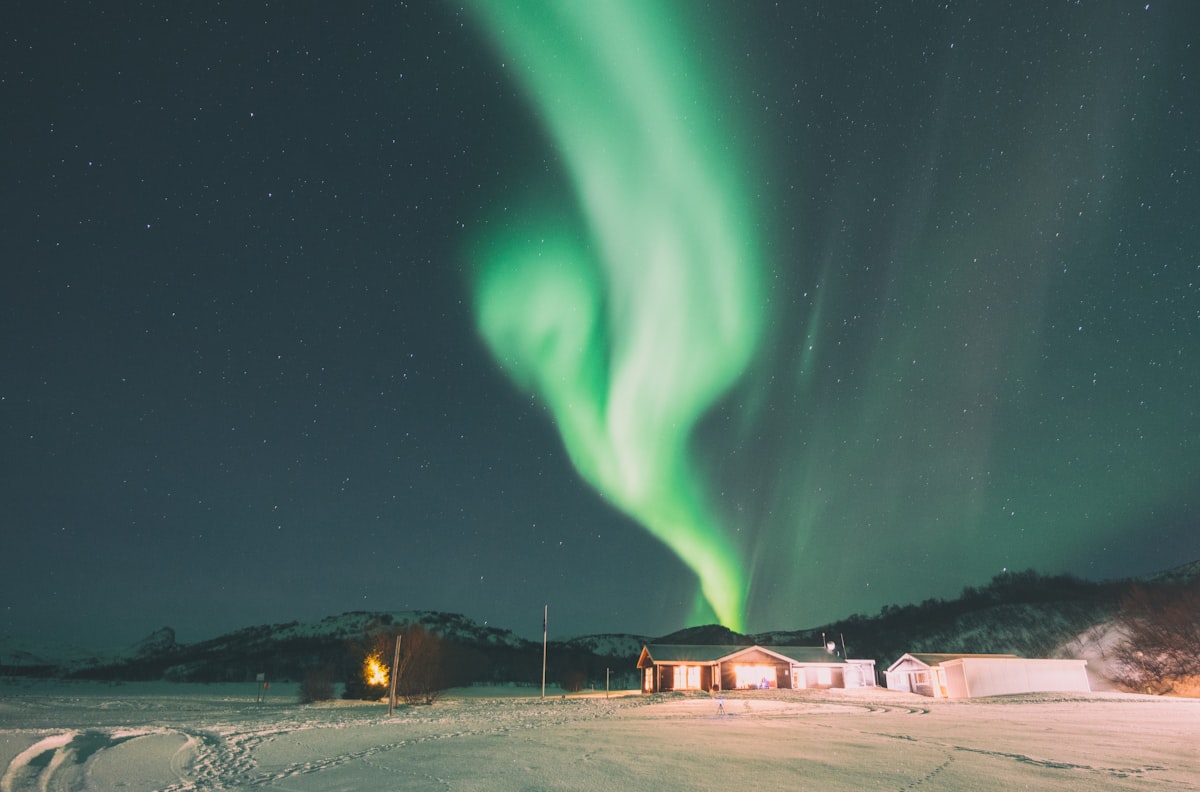
December is the month Iceland gives you the most darkness it has. Around the winter solstice the sun is above the horizon for barely four hours, which leaves close to twenty hours of night — more sky-watching time than any traveler can realistically use.
It is also, statistically, one of the hardest months to actually see the aurora. Both of those things are true at once, and understanding why is the whole difference between a great December trip and a frustrating one.
Almost Twenty Hours of Darkness
The numbers are genuinely extreme. On December 1 the sun rises in Reykjavík around 10:45 and sets at about 15:47 — roughly five hours of daylight. By the solstice on December 21 it’s down to 4 hours and 17 minutes, with sunrise near 11:20 and sunset around 15:30. By December 31 you’re at 4 hours 20 minutes and climbing again, barely. (Iceland stays on UTC year-round, so there’s no clock change to track.)
The practical effect: the sky is fully dark by late afternoon and stays dark until nearly lunchtime. You can be watching for the aurora at 17:00 and still be watching at 03:00. Since the aurora is bursty and unpredictable, more dark hours outside means more chances to catch a substorm. The 22:00–01:00 window is still the statistical sweet spot for the strongest displays — see our guide to the best time of night to see the northern lights — but in December you genuinely have the option to keep looking either side of it.
December’s Real Problem Is Weather, Not Darkness
Here’s the honest catch. December sits in the heart of the North Atlantic storm track. It is statistically one of Iceland’s cloudiest, windiest and wettest months, and low cloud is by a wide margin the number-one reason travelers go home without seeing anything. The geomagnetic forecast can be excellent and completely irrelevant if there’s a solid deck of cloud between you and the sky.
The saving grace is that Iceland’s weather is intensely local. A front parked over the south coast often leaves the north or the east under clear sky, and gaps open behind every storm system. In December, the single biggest factor in whether you see the aurora isn’t the Kp number — it’s whether you can move to where the sky is clear.
That’s exactly the gap our live aurora forecast closes: 100+ monitored spots scored every five minutes using real-time vedur.is cloud observations alongside the aurora model, so you can see which specific location is both clear and active right now rather than guessing from a national map. For the full strategy, read what to do when it’s cloudy.
Target the New-Moon Week: December 5–13
With darkness effectively unlimited, the moon becomes a lever worth planning around. A full moon won’t hide a strong display, but it washes out the faint and moderate auroras that make up most nights, and it flattens the contrast that makes photographs work.
In December 2026 the new moon falls on December 9, so the darkest skies of the month run roughly December 5–13. If your dates are flexible and you care about faint displays or photography, that’s the week to book. Note that the full moon lands on December 24 — Christmas Eve and the days around it will be the brightest, most moonlit nights of the month. If those are your dates, head to your darkest spot and hope for an active night rather than a subtle one.
Realistic Sighting Odds in December
Combining maximum darkness, an elevated solar-cycle background, and a heavy discount for winter cloud, here are honest probabilities for a traveler with a car who is willing to chase clear sky:
- 3 nights: ~55% chance of at least one visible display
- 5 nights: ~76–80% chance
- 7 nights: ~87–89% chance
That lands essentially level with November. December’s extra dark hours and its worse weather cancel each other out almost exactly. The lesson is the same one every month of the season teaches: book more nights than you think you need. Three nights in December is a coin flip; a week is close to a sure thing.
Winter Driving, Holiday Prices, and Where to Go
December is real winter, and that changes the logistics.
Roads. The Ring Road stays open and maintained, but the highland F-roads are closed, snow and ice are constant, and high winds close sections at short notice. You want a vehicle with proper winter tires and the confidence to use it. Check road.is before every drive, and plan your driving for the few daylight hours — navigating unfamiliar icy roads in the dark is a different task entirely.
Prices. Christmas and New Year push accommodation and car rental 30–50% above shoulder-season rates, and the last week of December books out early. The first half of the month is both cheaper and — conveniently — the new-moon window.
Three spots that hold up well in December:
- Þingvellir National Park — 45 minutes from Reykjavík on a maintained road, genuinely dark, and easy to reach on a short winter afternoon.
- Jökulsárlón glacier lagoon — icebergs make unbeatable foregrounds, and the southeast often catches clear slots when the southwest is socked in.
- Mývatn — high magnetic latitude, very little light pollution, and the north frequently stays clear while Atlantic fronts sit over the south.
Standing still outdoors for an hour in a December wind is colder than almost anyone expects. Our winter packing list covers what that actually requires.
Planning a December 2026 Trip
- Forget the dark window — it’s the least of your problems. Put your planning energy into weather flexibility and mobility.
- Aim for December 5–13 if you can choose. Darkest skies, lowest prices, and no holiday crowds.
- Stay mobile and book a base with roads running in several directions, rather than committing to one remote valley.
- Install the Aurora Iceland app and turn notifications on before you land. We score 100+ locations every five minutes on live solar wind, OVATION output and real cloud observations — if anywhere on the island is clear and active, the app tells you which spot, and when to leave.
If your dates fall a little earlier, our guide to the northern lights in November 2026 covers the month before this one, and how to read an aurora forecast explains the Kp, Bz and OVATION numbers underneath it all.
December hands you the longest nights Iceland will ever offer. Bring the warmest coat you own, keep your plans loose, and let the forecast tell you where the clear sky is — then go stand under it.