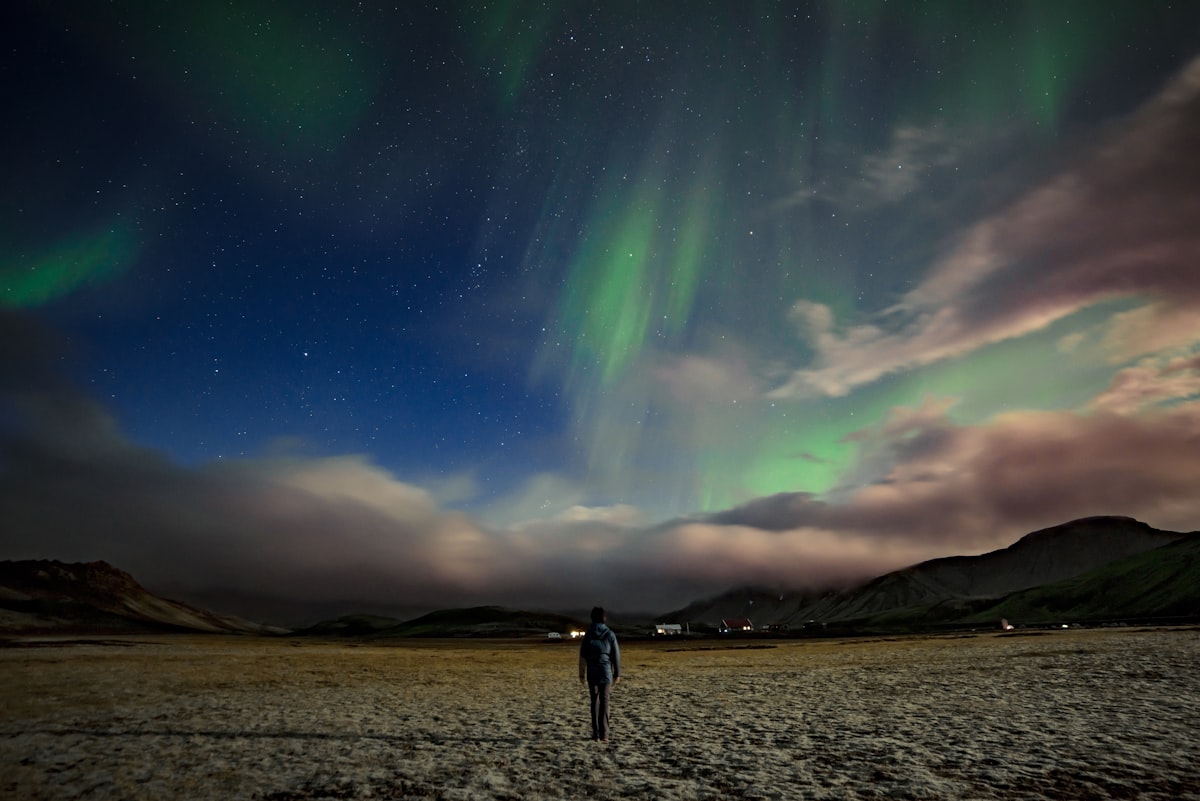
The Season Is Open
At 22:40 on the night of 28 August, a user of our app photographed a pale green aurora over Borgarnes and posted it to the community feed. It is the first aurora sighting logged in Iceland this season — the first since the sky went white in April.
We had spent the last two weeks telling people not to expect this yet. We were wrong about the timing, and the reason we were wrong is the most useful thing in this article.
The First Sighting Came in the Worst Light of the Year
Run the numbers for that exact moment at that exact spot and the conditions are close to the worst a person could pick.
- The sun was 9.6° below the horizon. That is the middle of nautical twilight. It is not darkness. True astronomical night — the sun a full 18° down — does not reach Reykjavík until 2 September, and on 28 August the sun never got deeper than about 16° below the horizon anywhere in the country.
- The moon was 99.4% illuminated and 10.7° above the horizon. The full moon fell at 04:18 that same morning. It rose at 20:48 and did not set until 07:50, so it was up for the entire usable window.
- The residual daylight was in the wrong place. At 22:40 the sun sat at azimuth 318° — northwest. The aurora appears in the north from Iceland, so the leftover sunset glow was sitting almost exactly where you go looking for the lights. You can see it in the photo: an orange band still burning along the horizon underneath the green.
Twilight from below, a full moon from the side, and no astronomical darkness available anywhere in Iceland. The aurora was visible anyway.
The Storm That Under-Delivered
The other half of the story is that the geomagnetic side of this did not go to plan either.
NOAA issued a G2 (Moderate) storm watch on 26 August predicting G2 conditions for both 28 and 29 August, driven by a coronal hole stream followed by two CMEs. We wrote that storm up on 27 August and said plainly that Iceland was the wrong place to be for it.
What actually arrived was smaller. The observed planetary Kp peaked at 4.33 in the 21:00–24:00 window that contains this sighting — active, but below the Kp 5 threshold that even counts as a G1 minor storm, and well short of the predicted G2. NOAA issued a K5 warning at 20:40 that night; the index never got there.
So the display that opened the season was produced by a storm that came in under forecast, seen through twilight, under a full moon. If you have ever wondered why we are so insistent that a single national Kp number is a poor way to decide your evening, this is the cleanest example we have had all year.
Darkness, Not the Sun, Was the Limit All Summer
Here is the part worth carrying into September.
The aurora did not switch on this week. It has been there all along — the auroral oval does not take the summer off. What changed is that the sky finally got dark enough, for long enough, that a camera at a rural spot could pick it out of the background. All summer the limiting factor was never solar activity. It was light.
That reframes the next three weeks entirely. Tonight, 29 August, Reykjavík gets nautical twilight from 23:05 to 03:52 — nearly five hours of usable sky — but zero minutes of true astronomical darkness, with the sun bottoming out 16.8° down at almost exactly due north. Every night from here, that window deepens.
The Real Opening Is 7–20 September
The number that actually predicts a good night is not moon phase and it is not darkness on its own. It is moon-free darkness: hours when the sun is more than 18° down and the moon is below the horizon. Computed for Reykjavík:
| Night | Astronomical dark | Moon-free dark |
|---|---|---|
| 29 Aug – 1 Sep | 0.00 h | 0.00 h |
| 2 Sep | 1.08 h | 0.00 h |
| 5 Sep | 2.48 h | 0.00 h |
| 7 Sep | 3.08 h | 1.72 h |
| 8 Sep | 3.35 h | 3.35 h |
| 11 Sep (new moon) | 4.05 h | 4.05 h |
| 15 Sep | 4.83 h | 4.83 h |
| 20 Sep | 5.68 h | 5.68 h |
Astronomical night returns on 2 September, but the waning moon eats all of it for the first five nights. The first night of the season with any genuinely dark, moonless sky is 7 September, and from 8 September onward the entire dark window is moon-free, right through the 11 September new moon and on to the equinox.
That is the window to plan around. Our moon phase guide explains why phase alone will mislead you, the darkness dates article has the numbers for towns outside Reykjavík, and the September guide covers the month in detail.
What to Expect, and Where to Go
Do not calibrate on the photographs. An early-season display is a faint green band or a set of soft rays low in the north, more structured and far more colourful to a camera than to your eyes. Our guide to what the northern lights actually look like to the naked eye is the single best thing to read before a first attempt.
Borgarnes — where this sighting happened — is about an hour from Reykjavík with an open northern horizon over the water. Grótta Lighthouse is the closest usable spot to the city, and Þingvellir is darker and only 45 minutes out. At this time of year cloud decides more nights than solar activity does, so check a spot before you drive to it rather than after.
Check Before You Drive
The live aurora forecast scores 137 viewing spots across Iceland every five minutes on real cloud, darkness and solar wind — not one national number. The Aurora Iceland app does the same on your phone, and alerts you when the solar wind turns favourable while the sky where you are is dark and mostly clear, or when aurora sightings are reported near you.
Somebody stood in Borgarnes under a full moon, in twilight, during a storm that fell short of its forecast, and saw the northern lights anyway. In ten days the sky will be properly dark and the moon will be gone.
The season is open. Go and look north.