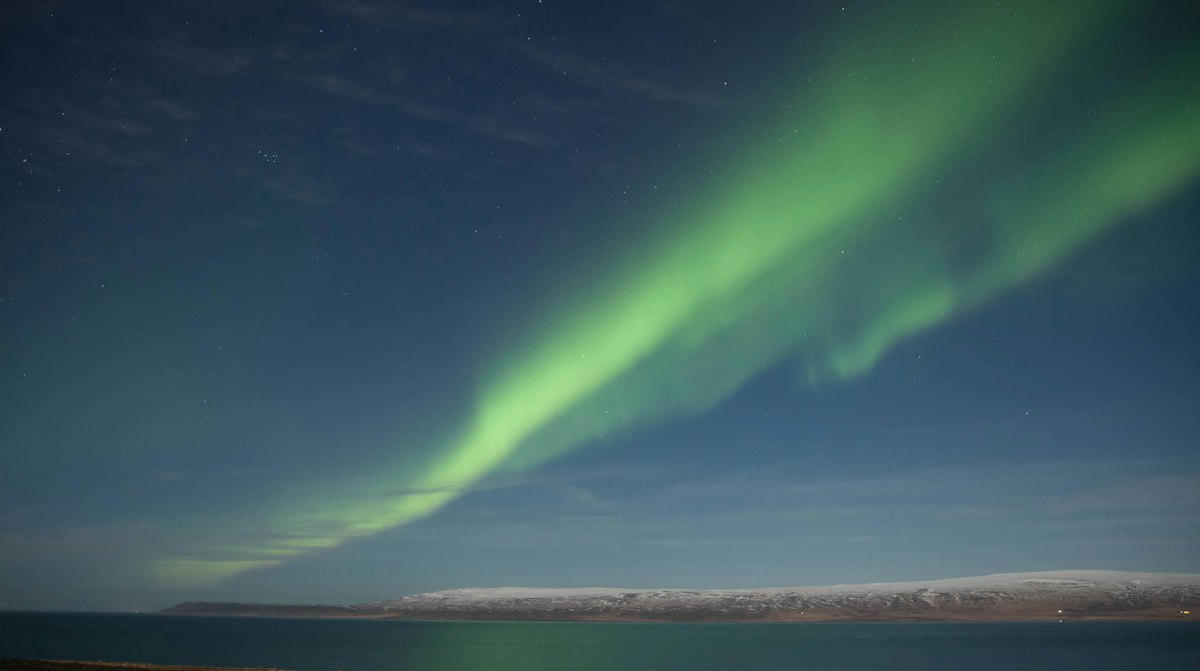
February Is Where Long Nights Meet Rising Storm Odds
February is a crossover month. The nights are still long, with more than eleven hours of true darkness at the start of the month. At the same time, the geomagnetic odds start climbing out of their midwinter low toward the March equinox.
No other month has both. December and January have more darkness but fewer storms. March has more storms but loses darkness fast. This guide sets out the darkness, the moon dates and the honest odds, and then answers the question most February planners end up asking: should you wait for March?
How Much Darkness February 2027 Gives You
We computed these figures for Reykjavík from the sun’s position. Iceland stays on UTC all year, so there is no clock change to track.
| Date | Daylight | Astronomical darkness |
|---|---|---|
| 1 February | 10:05 to 17:17 (7.2 h) | 20:07 to 07:15 (11.1 h) |
| 15 February | 09:21 to 18:03 (8.7 h) | 20:44 to 06:39 (9.9 h) |
| 28 February | 08:37 to 18:44 (10.1 h) | 21:23 to 05:56 (8.6 h) |
Astronomical darkness is when the sun is 18 degrees below the horizon and even faint aurora is in range. A bright display is readable earlier, from about 12 degrees down, and that window runs 13.0 hours on 1 February and 10.5 hours by the 28th. Akureyri, Ísafjörður and Vík stay within about 20 minutes of Reykjavík all month.
Daylight is what changes fastest. You gain almost three hours of it between 1 and 28 February, so by the end of the month most of your driving happens in the light.
The Moon Dates That Matter
The new moon is on 6 February 2027 (15:56 UTC) and the full moon is on 20 February (23:23 UTC). What counts for aurora is how many dark hours you get with the moon below the horizon. Phase alone does not tell you that, as our moon phase guide explains.
- 1 to 8 February: the moon is below the horizon for all, or almost all, of the dark window. That is 10.5 to 11.1 hours of moon-free darkness a night in Reykjavík, the longest of the month.
- 9 to 13 February: the moon sets later each night, from about 22:00 on the 9th to about 05:20 on the 13th. The dark hours after moonset shrink from about 8.9 to under 1.5.
- 14 to 21 February: the moon is up for the whole dark window. A strong display will still show, but faint arcs will be washed out.
- 22 to 26 February: the moon rises later each night, from about 21:45 on the 22nd to about 05:45 on the 26th, so the evening is dark again.
- 27 and 28 February are fully moon-free, and that stretch runs on until 9 March.
Across the month, Reykjavík gets about 152 hours of moon-free darkness, against 219 in January and 117 in March.
What the Aurora Odds Honestly Look Like
In GFZ Potsdam’s planetary Kp record, which runs back to 1932, 6.9% of February’s three-hour periods reach storm level (NOAA G1 or above). January is at 4.5%, December at 4.1% and March at 9.5%.
The rise is not even across the month. Split into ten-day blocks, February runs 6.5%, 6.3% and then 8.3% for 21 to 28 February. That last week already beats mid-March (7.6%), because the equinox effect is a season of several weeks either side of the date, not a single day.
Storm odds are not the same as your odds of seeing aurora. Most Icelandic aurora is seen on ordinary nights, and the practical limit is cloud. Reykjavík averages 5.9 eighths of cloud cover in February, about the same as every other month. February is the windiest month in Reykjavík (5.5 m/s on average) and averages 0.6°C, so dress for standing still in wind chill.
February or March?
Choose February if darkness matters most to you. The first week of February gives you more than ten moon-free dark hours a night. By the end of March, Reykjavík gets four hours of darkness and Ísafjörður under three.
Choose March if you want the best storm odds per hour and more daylight for driving. A big, fast-moving display is noticeably more likely.
The best compromise is 26 February to 9 March. Those twelve nights are moon-free, with 7.5 to 8.7 hours of darkness each, and they sit in the steepest part of the climb toward the equinox.
Roads in February
February driving looks much like January’s, with more daylight to do it in. The Ring Road and the main routes off it are cleared. The south, from Þingvellir out to Hella and on towards Vík, is the easiest base to reach every night, and roads there run in several directions, so you can follow a clear sky. See what is available on the south coast.
For the north, fly to Akureyri rather than driving the mountain passes. Highland F-roads are closed, and in the Westfjords the Strandir road gets no scheduled snow clearing until 20 March. Check road.is at around 20:00, then the cloud map, before you pick a direction. Our winter roads guide covers both habits. If you need a car, compare cars and campervans across 30+ Icelandic suppliers.
Some links in this guide are affiliate links: we earn a commission if you book, at no extra cost to you. It never affects what we recommend or how we score a spot.
Planning a February 2027 Trip
- Aim for 1 to 8 February for the longest moon-free nights, or 26 February to 9 March for moon-free nights with rising storm odds.
- Avoid building a short trip around 14 to 21 February, when the moon is up all night.
- Book more nights than you think you need. A clear sky and an active night have to arrive together, and each extra night is another chance.
- Install the Aurora Iceland app before you land. We score 137 locations every five minutes on live solar wind and real cloud observations. The app alerts you when the solar wind turns favourable while the sky where you are is dark and mostly clear, or when aurora sightings are reported near you.
If you are travelling a month earlier, see our guide to the northern lights in January 2027. Whatever your dates, the live aurora forecast shows which reachable spot is clear right now.