There is one piece of aurora forecasting that works three weeks out, costs nothing, and almost nobody tells travellers about. It is this: if you read about an aurora storm in Iceland, put a note in your calendar 27 days later.
NOAA’s current 27-day outlook is the worked example. It has exactly one strong run in it, on 24-26 September — the strongest geomagnetic forecast of the season so far. Subtract 27 days and you land on the last week of August, which is the storm we wrote about at the time. The same patch of sun is coming back round.
The Trick: The Sun Turns Once a Month
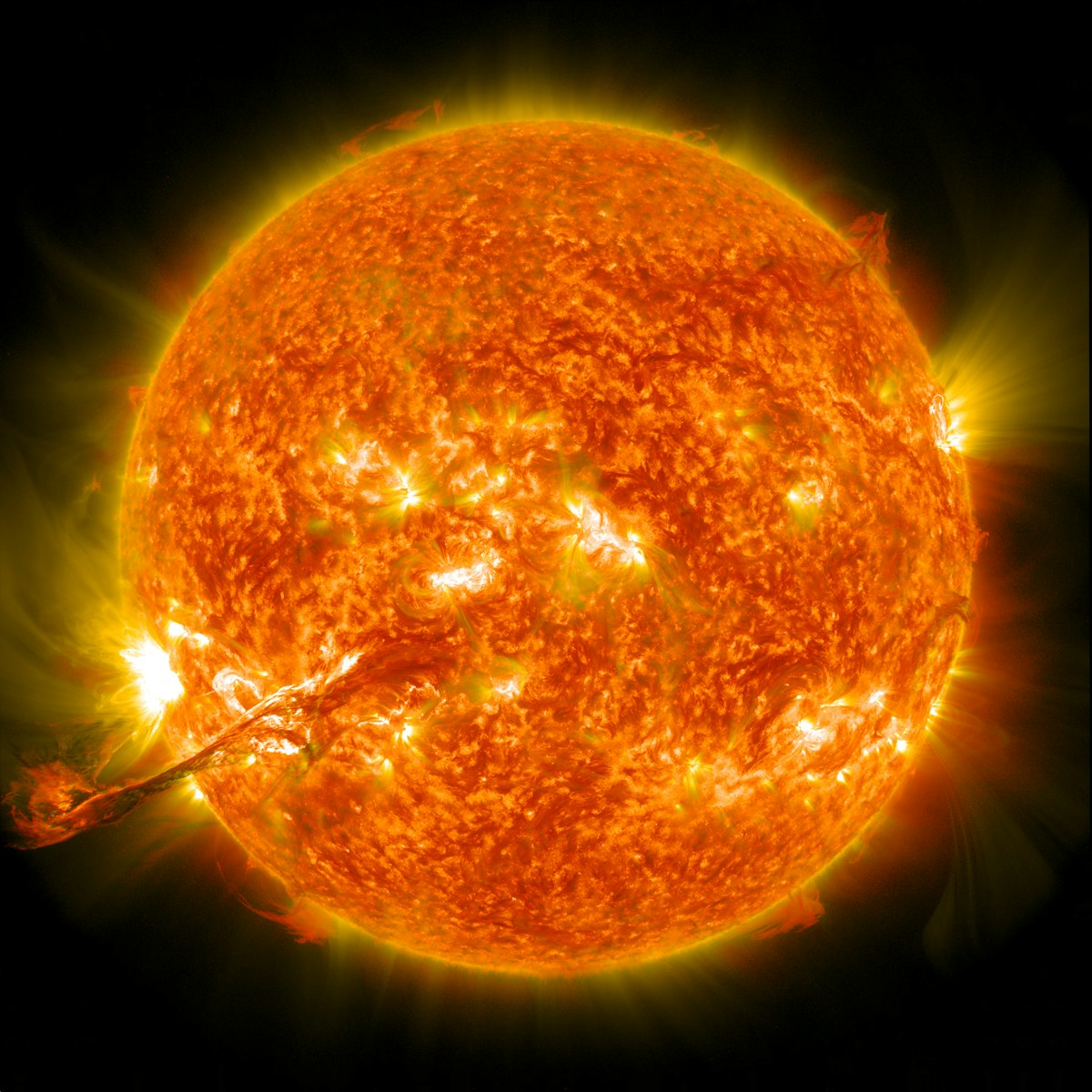
The sun is not solid, so it does not rotate all in one piece — the equator turns faster than the poles. But the part of it that throws solar wind at Earth comes back around roughly every 27 days as seen from here.
Some aurora is caused by a coronal mass ejection: a discrete cloud of plasma thrown out by an eruption. That is a one-off. It happens, it hits, it is gone, and it never comes back.
But a lot of aurora is caused by a coronal hole — a gap in the sun’s magnetic field where the solar wind escapes faster than usual. A coronal hole is not an event. It is a feature, and features sit still while the sun turns underneath them. So it sweeps past Earth, stops pointing at us, and then swings back into view about 27 days later, often still there.
That is the whole mechanism, and it is why the outlook runs to 27 days rather than 30.
The Worked Example: Our Own Storm, Returning
Here is the arithmetic, using observed data rather than the forecast that preceded it. These are NOAA’s estimated planetary A-index values for the storm days in August, against the same product’s forecast for September:
| Late August (observed) | Ap | One rotation later | Ap (forecast) |
|---|---|---|---|
| 28 August | 15 | 24 September | 20 |
| 29 August | 17 | 25 September | 22 |
| 30 August | 15 | 26 September | 22 |
The dates line up almost to the day. That is not a coincidence and it is not clever forecasting — it is a calendar.
What Recurrence Predicts, and What It Does Not
This is where most explanations stop, and it is where the useful part starts. Recurrence predicts the solar wind. It does not predict the sky over Iceland. Three separate things get in the way.
Only half of August’s storm is the kind that repeats. NOAA’s watch comment at the time was blunt about the mix: “HSS on 27 + CMEs on 28-29.” A high-speed stream from a coronal hole on the Thursday, then coronal mass ejections over the weekend. Only the first of those recurs. And there is an awkward detail in the observed record: 27 August, the day the recurring component was due, was flat — planetary Ap 4, with no three-hour Kp above 1.33. The activity did not show up until the CMEs did. The two drivers overlapped, so the credit cannot be cleanly split, but the part of August that is coming back is at best a share of what made August interesting.
Three weeks of lead is a long way out. We have written before about how accurate the aurora forecast actually is at each range, and the honest answer for a 27-day outlook is that it is close to noise beyond about a week. The Kp 5 pencilled in for the 25th and 26th is an estimate made 18 to 21 days ahead. Treat it as a reason to look, not as a promise.
And it says nothing about cloud — which loses more Icelandic aurora nights than solar activity ever does.
The Moon Is Already Waiting
This is the caveat nobody else supplies, and for 24-26 September it is decisive.
The moon is full at 16:48 UTC on 26 September. So the return arrives in the worst possible lunar week. We ran the numbers for Reykjavík:
| Night of | Astronomical dark | Moon-free dark | Moon |
|---|---|---|---|
| 21 Sep | 5.8 h | 4.4 h | 78% |
| 22 Sep | 6.0 h | 2.5 h | 85% |
| 23 Sep | 6.1 h | 0.8 h | 92% |
| 24 Sep | 6.3 h | 0.0 h | 96% |
| 25 Sep | 6.4 h | 0.0 h | 99% |
| 26 Sep | 6.6 h | 0.0 h | 100% |
Zero on all three nights. Not “compromised” — zero. On the night of 25-26 September the moon never drops below 14 degrees above the horizon at any point during the 6.4 hours of astronomical darkness. It is up, it is bright, and it is there for all of it.
Notice the shape of that table, because it is cruel. Iceland has plenty of darkness in late September and plenty of moon-free hours on the 21st and 22nd — and the activity is forecast to arrive precisely as they run out. It is the exact inverse of the mid-September window, where a modest Kp 3 lands on hours of genuinely dark sky.
We are not writing these nights off. A bright moon does not switch the aurora off, it raises the floor: faint structure disappears, and a strong display still gets through. If the forecast Kp 5 actually verifies, that is roughly the level at which a display is bright enough to hold its own against a full moon, and you would see something. It is a genuine long shot rather than a dead loss — but it needs the strong version of the forecast to come true, on a night when it has to be strong to count at all. The full mechanics are in our guide to how the moon affects the northern lights.
What to Actually Do With This
The 27-day rule is worth knowing because it works at a lead time nothing else reaches, and because it costs you one line in a calendar. Use it the way a forecaster would:
- When a storm happens, note the date. Add 27 days. That is your candidate.
- Check the moon for that date before you get excited. This is the step everyone skips, and it is the one that decided 24-26 September before any space weather was involved.
- Wait for the 3-day forecast. Around 21-23 September these dates enter the deterministic products, and that is when a rotation estimate turns into a real forecast. Our guide to reading an aurora forecast covers which numbers matter at which range.
The honest advice is unchanged: book the darkness, not the storm. Darkness is astronomical fact and will not be revised. For the nights after this one, see our October 2026 guide — the moon clears out again in the first half of the month.
And on the night itself, the only number that matters is the one where you are standing. Our live aurora forecast scores 137 monitored locations across 14 regions every five minutes on solar wind, OVATION output and observed cloud, and the Aurora Iceland app will tell you which of them is clear and active right now.