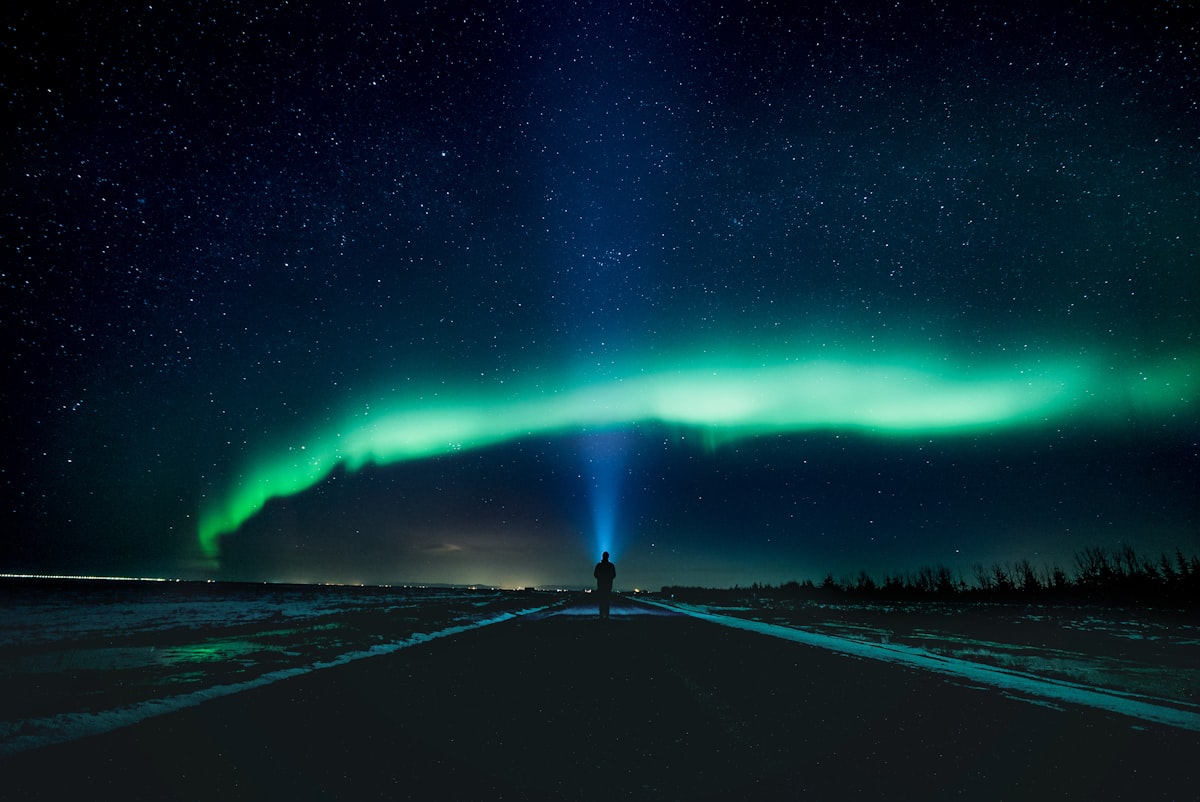
Three separate data sources have just landed on the same week, and as far as we can tell nobody else is reading all three of them together. NOAA’s current 27-day outlook has exactly one stretch of elevated geomagnetic activity in the next three weeks. It falls on 12-16 September. Those are also the first nights of the 2026-27 season on which Iceland has real astronomical darkness with the moon completely out of the sky.
That has not happened once yet this season. It is worth being precise about why, because the reason is not the one most aurora coverage gives.
Update, 6 September: The Window Has Opened
This article was published on 30 August and said the first usable conditions would arrive around 7-8 September. They have. Here is what changed, and one detail that cuts against us which we would rather print than leave out.
The night of 8-9 September is the first night since April with more than three hours of genuinely moon-free darkness. Astronomical night over Reykjavík runs 23:45 to 03:06 UTC, and the moon is below the horizon for every minute of it — 3.4 hours. The moon is only 6 percent lit that night, but that is not the reason it does not matter. The reason is that its highest point all night is 2.8 degrees below the horizon. It never comes up at all. That is the first time this season the geometry has worked out that way, and it is a close-run thing: one night earlier, on 7-8 September, the moon rises inside the dark window and takes 1.4 of the 3.1 dark hours with it.
On the space-weather side, NOAA’s 3-day forecast issued 6 September at 00:30 UTC has a CIR ahead of a positive-polarity coronal high-speed stream, with CME influence, arriving across 7-8 September. Activity climbs from a nearly dead 6 September (max Kp 1.67 across all eight bins) to Kp 3.67 on the 7th and 4.00 on the 8th.
NOAA still states plainly that no G1 or greater storms are expected, and we are not going to upgrade that.
The near-miss, because it is the honest detail
The forecast’s single highest bin is Kp 4.00, and it runs 03-06 UTC on 8 September. Astronomical darkness that night ends at 02:59 UTC. The peak is forecast to land one minute after the sky stops being dark.
Kp bins are three-hour averages, so activity may well be climbing before 03:00 — but the headline number and the dark window do not overlap, and anyone telling you the 8th is a big night is quoting a figure that arrives after sunrise-in-the-astronomical-sense. The genuinely good window is the following night, the 8th into the 9th, which is forecast at Kp 3.00 in the 21-00 UTC bin. The rest of that night falls past the end of the current 3-day issue, so we do not know it yet. We will not pretend otherwise.
What that means if you are out this week
The night of 8-9 September is the one to plan around: weaker on paper than the storm two weeks ago, and far better in practice, for exactly the reason this article was written. If you only get one night, take that one. Aurora tends to pick up after local midnight, which is covered in the best time of night to look.
How it turned out: we picked the wrong night. The activity arrived early, holding Kp 4.33 across the dark hours of 7-8 September and drawing the season’s first real cluster of sightings, while 8-9 September came in at Kp 3 under cloud. NOAA also issued a G1 watch for the 8th a couple of hours after this update was published, which we should have added here. The full account is in the aurora came a night early.
And the main event has not moved. 12-16 September is now confirmed by a second consecutive NOAA outlook, which is better evidence than the single issue this article was originally built on.
What the Forecast Actually Says
Here are the numbers, from NOAA SWPC’s 27-day outlook. When this article was first published they came from the issue of 24 August; the current issue is dated 3 September 2026 and repeats the run unchanged. Two consecutive issues agreeing, at shortening lead time, is meaningfully stronger evidence than one:
| Date | Planetary A index | Largest Kp |
|---|---|---|
| Sep 10-11 | 5 | 2 |
| Sep 12 | 8 | 3 |
| Sep 13 | 15 | 3 |
| Sep 14 | 12 | 3 |
| Sep 15 | 8 | 3 |
| Sep 16 | 8 | 3 |
| Sep 17-23 | 4 - 5 | 2 |
Every other day between now and 23 September sits at Ap 4-5 / Kp 2. So this is the only thing moving in the near term. (The 3 September issue does add one further run beyond the end of this table, on 24-26 September, and it is forecast stronger — but the moon is above the horizon for the whole of all three of those nights, which is the trade this entire article is about. We work through that return, and the 27-day rule behind it, in why the same aurora storm comes back 27 days later.)
And it is not a storm. Kp 3 is unremarkable. It is not a G1, there is no watch, and NOAA’s 3-day forecast — reissued daily, and re-checked for this update on 6 September — still states plainly that no G1 or greater storms are expected. If you have seen a site describing mid-September as a major event, they are overselling a rotation estimate. We are not going to do that, because the interesting part is somewhere else entirely.
The Inversion: Why a Kp 3 Night Beats the Kp 4.3 You Just Missed
On 27-29 August Iceland sat under a NOAA G2 watch, a K5 warning, and a real geomagnetic storm. Observed planetary Kp peaked at 4.33 on 28 August. Across all three nights of it, Reykjavík had zero hours of darkness with the moon below the horizon, because a near-full moon was up for the entire short window that counted. The whole country got one faint photograph out of it, from Borgarnes.
Now compare that with 13 September. Forecast Kp 3 — a weaker night by every space-weather measure — falling on 4.45 hours of astronomical darkness with the moon below the horizon for all of it.
The weaker night is the better night. Here is the arithmetic, computed for Reykjavík the same way we model it internally:
| Night of | Astronomical dark | Moon-free dark |
|---|---|---|
| Sep 2-6 | 1.1 - 2.8 h | 0 h |
| Sep 7 | 3.1 h | 1.7 h |
| Sep 8-11 | 3.4 - 4.1 h | all of it |
| Sep 12-16 | 4.3 - 5.0 h | all of it |
| Sep 17-20 | 5.2 - 5.7 h | all of it |
| Sep 21-23 | 5.8 - 6.1 h | 4.4 / 2.5 / 0.8 h |
| Sep 24-30 | 6.3 - 7.1 h | 0 h |
New moon is 11 September, one day before the active run starts. On the 12th the moon is 3 percent lit and sets at 19:25, nearly four hours before astronomical night begins at 23:16. By the 16th it is 31 percent lit and still sets before dark. That is the point we keep making about moonlight and almost nobody else does: what ruins a faint aurora is not a bright moon, it is a moon that is above your horizon. The full mechanics are in our guide to how the moon affects the northern lights.
There is one more thing worth saying, and it is the reason we trust this more than we otherwise would. Our September 2026 guide already recommended 14-20 September as the best week of the month. That recommendation was published on 24 August, derived from darkness and moon geometry alone, with no knowledge of any geomagnetic forecast. The space-weather outlook has now landed on top of it independently. Two methods, no shared inputs, same week.
Two Caveats We Would Rather Publish Than Bury
A 27-day outlook at 13 days of lead is weak. It is an extrapolation of solar rotation, not a prediction: the Sun turns once every 27 days, so a region that was active last time around gets pencilled in for a repeat. Often it has decayed by then. We would treat this as firm only when 12-16 September enters the deterministic 3-day forecast, around the 9th to the 13th — which has still not happened. What has happened since we first published is that a second, independent issue of the outlook repeated the same run, which is the next best thing. Our piece on how accurate the aurora forecast actually is covers what each lead time is worth.
Cloud decides more Icelandic nights than Kp does. It is the harder forecast and the one that actually loses people their trip.
Both caveats point the same way, and it is the useful conclusion: book the darkness, not the forecast. The moon-free window is astronomical fact and will not be revised. The Kp 3 is a bonus that may or may not show up. If the geomagnetic run collapses entirely, 12-20 September is still the best set of nights Iceland has had since spring.
What to Do With It
If your dates are movable, 12-20 September is the window — the first half has the forecast activity, the second half has more darkness, and all of it is moon-free. If you are already coming earlier, note that nothing before 7 September has a single moon-free dark hour, so plan around brighter displays only.
Go somewhere genuinely dark. Þingvellir is 45 minutes from Reykjavík, Kirkjufell on Snæfellsnes gives you the foreground, and Grótta is walkable from the city if you have one night and no car. Darkness arrives from the south upward at this time of year, which is covered in when aurora season actually starts in Iceland.
And check the real number on the night rather than a two-week-old table. Our live aurora forecast scores all 137 monitored locations across 14 regions every 5 minutes on solar wind, OVATION output and live cloud cover. The Aurora Iceland app will tell you which spot is clear and active tonight, which on most Icelandic nights is the question that actually matters.