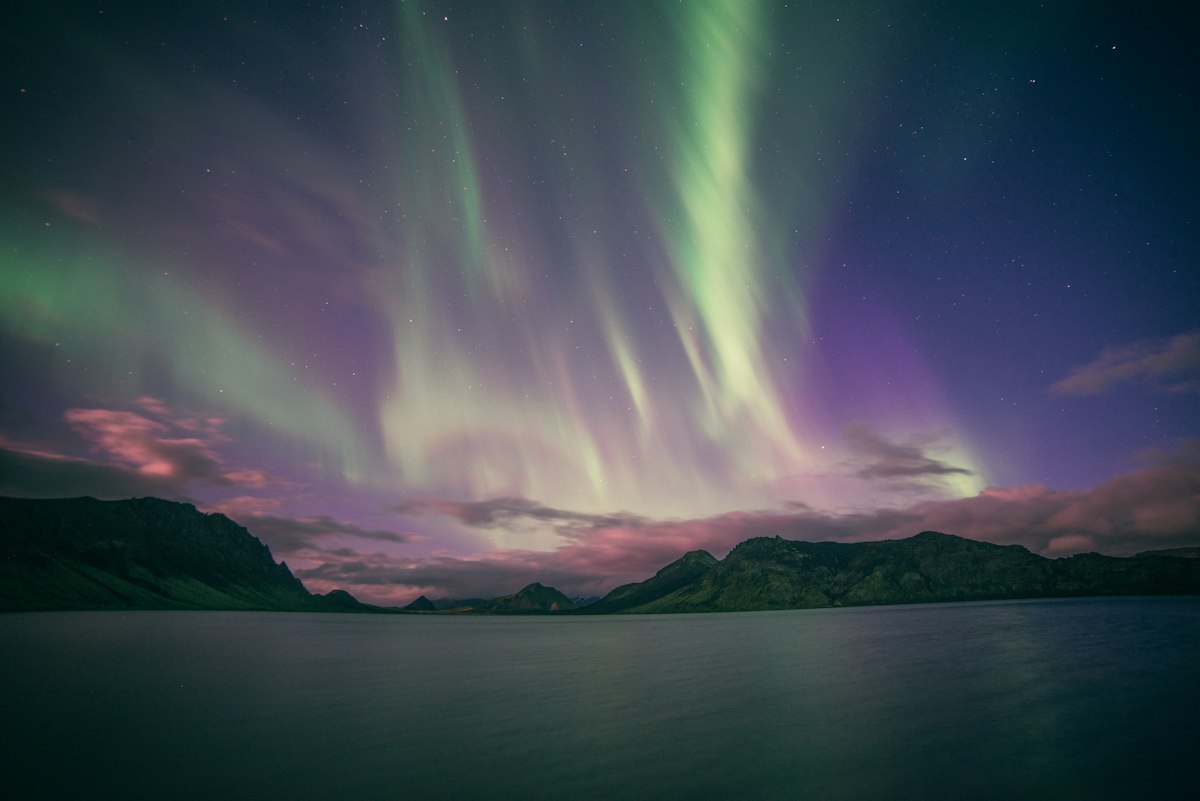
We Told You to Pick the Other Night
On 6 September we updated our September aurora window article with a plain recommendation: if you only get one night this week, take 8-9 September. It was the first night since April with more than three hours of astronomical darkness and the moon below the horizon for all of it. The night before, 7-8 September, looked like the same story at half strength, because the moon rose at 01:36 and cut its moon-free darkness to 1.7 hours.
It went the other way. The night of 7-8 September produced the first real cluster of aurora sightings of the 2026-27 season. The night of 8-9 September produced none. Here is what happened, from NOAA’s observed record, the cloud and our own community feed, and what it means for planning a night out.
What the Sky Actually Did
These are NOAA’s observed planetary Kp values for the two nights. Iceland runs on UTC all year, so the times are local.
| Night | Dark hours (moon-free) | Kp 21:00-00:00 | Kp 00:00-03:00 | Sightings logged |
|---|---|---|---|---|
| 7-8 Sep | 3.1 h (1.7 h) | 4.33 | 4.33 | 7 |
| 8-9 Sep | 3.4 h (3.4 h) | 3.00 | 2.67 | 0 |
The night with less darkness had more than a full Kp step more activity, right across its dark window.
There was a G1 storm as well, and it missed Iceland’s night entirely. Kp reached 5.00 between 06:00 and 09:00 on 8 September. NOAA’s K-index 5 alert fired at 07:30, an hour after sunrise in Reykjavík. A second K5 alert followed at 17:44, with the sun still up. That’s two minor-storm periods, both in daylight.
The Forecast Moved Faster Than We Did
Our 6 September update said NOAA expected no G1. That matched the 3-day forecast issued at 00:30 UTC that morning, and we published a little after 10:00. At 12:12 UTC, about two hours later, NOAA issued a G1 watch for 8 September. We did not revise the article, and we should have.
With hindsight, the timing was there too. NOAA’s forecast discussion that weekend modelled a combined arrival from several eruptions on 5 September for “early 08 Sep”. In Iceland that’s the back half of the 7-8 night, not the 8-9 night. Activity was already climbing on the 7th: NOAA’s K4 warning went out at 08:54 that morning, and a K5 warning at 20:01, two hours before the first sighting.
The next watch is the more instructive one. At 17:02 UTC on 8 September, NOAA upgraded to a G2 (moderate) watch for 9 September. For Iceland, the 9th starts at midnight, in the middle of the moon-free night we had recommended. By that evening, the best-darkness night also had the strongest forecast. It got neither. Kp fell to 2.67 after midnight and 1.33 before dawn, the highest three-hour value all day on the 9th was 3.00, and NOAA cancelled the watch at 21:01 UTC that evening.
Our piece on how accurate the aurora forecast is covers what each lead time is worth. This week added a clean example: a call made less than a day out that missed by a whole night.
Cloud Settled It Anyway
Even a G2 would not have helped most people on 8-9 September. The weather model’s hour-by-hour cloud record shows Reykjavík, Akranes, Selfoss and Heimaey at 0% cloud from 22:00 to 02:00 on 7-8 September, and at or near 100% for the whole dark window on 8-9 September. The far east was the reverse: Egilsstaðir was mostly overcast on the 7th and clear on the 8th.
These are modelled figures rather than station readings, but the pattern is unambiguous. The southwest, where most visitors stay, had one of its clearest nights of the season on the 7th and was overcast on the 8th. Our guide to reading the Vedur cloud map shows how to spot that difference before you get in the car.
It Did Not Wait for Full Darkness
Seven sightings from five different people were logged between 21:57 and 00:23. They came from the Westman Islands to Drangsnes on the Strandir coast, more than 250 km apart, with Akranes Lighthouse and the capital area in between. For comparison, from mid-May to the end of August the feed logged nine posts in total, and seven of those were people reporting that nothing was happening.
The timing is the surprise. We computed the sun’s altitude at each location at the moment each post went up. Six of the seven were posted before the sky was astronomically dark where the person was standing. The first two came with the sun only about 11 degrees below the horizon, in nautical twilight. Only the last, at 00:23 from Akranes, was under a fully dark sky. All seven were posted before the moon rose.
The season’s first photograph, over Borgarnes on 28 August, taught the same lesson. Astronomical darkness is what lets a faint aurora show, but an active one doesn’t wait for it. At Kp 4 and above, twilight is not a write-off, especially for a camera.
What to Take From It
- Book the darkness, decide on the night. The moon-free dates were right, because they’re astronomy. What decided which night won was the arrival time and the cloud, and neither was knowable two days ahead.
- Watch the watches, not only the 3-day table. The 3-day forecast is issued once a day, while watches and warnings change through the day. The K5 warning at 20:01 on 7 September was the signal that mattered.
- On an active night, go out at dusk. If Kp is already 4 when the sun goes down, do not wait for midnight.
Looking ahead, 12-16 September is still fully moon-free. NOAA’s 3-day forecast issued at 00:40 UTC today tops out at Kp 3.00 through 13 September with no storms expected. The accompanying discussion flags two slow CMEs with a possible weak impact late on the 14th into the 15th. The recurring stream due back on 24-26 September is covered in why the same aurora storm comes back 27 days later.
This week the right night only became obvious on the night itself. That is what the live aurora forecast is for: it scores all 137 locations every five minutes on solar wind, OVATION output and live cloud. The Aurora Iceland app will alert you when the solar wind turns favourable while the sky where you are is dark and mostly clear, or when aurora sightings are reported near you, so the decision gets made on the night rather than two days before it.